
Introduction
This article is a follow-up to my tips & tricks for making the most of wargames, and since some of you have asked about games where logistics matter a lot, here are a couple I think handle logistics in interesting ways. Each of them tackles logistics in its own way, with some being relatively easy to get into, while others will give you headaches worthy of the most complicated algebra classes. While real-life commanders had plenty of staff to help them deal with these problems, these decisions fall squarely upon your shoulders.
Unity of Command II

While it looks bright and approachable compared to the spreadsheet-heavy menus of War in the East, Unity of Command II is fundamentally a game about cutting your enemy’s supply lines while desperately protecting your own. It acts as an incredibly tight operational puzzle of the European theater of WWII. Supply isn’t an abstract radius here; it is an active flow from fixed railheads, ports, and modular, moveable supply hubs that can be captured and cut off if you’re not careful. Your trucks can only push supplies a set number of hexes down operational roads or rails before the line pales out. If an enemy unit steps onto a road behind your spearhead, they sever the supply thread, and you run the serious risk of finding yourself without ammo, food, and fuel to proceed with your advance. Units left out of supply quickly see their combat effectiveness go down significantly. UoC II is a great game at forcing you to consider your movement versus how you’re going to sustain your advance. Sure, you can move 10 hexes ahead and reach that village, but can you keep the momentum going? Or are you just going to isolate yourself?
Cauldrons of War

Cauldrons of War (Barbarossa and Stalingrad) looks less like a traditional hex-and-counter wargame, and it’s a weird title that cannot really be compared to something else. It’s a grand strategy in the truest sense of the word. It completely strips away the hundreds of hours of map micro-management found in “monster” wargames, focusing purely on high-level strategic decisions, and at that level, logistics is the entire game. Resupply happens automatically between turns, but it relies entirely on local rail infrastructure, which is rarely enough to sustain heavy fighting. To keep your panzers or shock armies rolling, you must manually execute force-supply commands using Command Points (CPs), forcing you to prioritize areas of the front, as real commanders had to do.
Decisive Campaigns Series

This operational-level WWII game blends traditional hex-based combat with deep management mechanics, emphasizing the strained relationship between the frontline generals and the high command. As the commander, you have a finite number of supplies, and you must make hard choices about which army groups receive priority. If my memory doesn’t fail me, the most recent game of the series, Decisive Campaigns: Ardennes Offensive, even had a congestion mechanic, so you could find yourself with enough supplies, but your trucks just weren’t moving fast enough to deliver them.
Hearts of Iron IV

Hearts of Iron IV is my favorite Paradox Interactive game, and the premier WWII grand strategy game for the wider audience of gamers. Despite its accessibility, it has a tremendous amount of depth when it comes to logistics management, something I have experienced with my first-hand failures plenty of times. Victory requires managing global supply hubs, railways, and motorization levels. Troops require a continuous flow of infantry equipment, tanks, and artillery from your domestic factories. Troops fighting in infrastructure-poor regions like Siberia or North Africa will suffer crushing attrition if you haven’t upgraded the local port capacity or assigned enough trucks to distribute the crates. This can even extend to the way you build and design your own divisions, since you can individually customize each to lighten the load your template has on your logistics, if you need.
Shadow Empire

One of the best 4X games ever made, Shadow Empire is a brilliant, gritty hybrid of a sci-fi 4X game and a traditional hex-and-counter wargame. Set on a procedurally generated, post-apocalyptic planet, you play as a warlord attempting to reunite a fractured world. Logistics is the literal circulatory system of your empire. You must construct a network of dirt roads, paved highways, and mag-rail lines. Every turn, supply points flow from your zone hubs through this network. If a road bottlenecks due to overcapacity or gets cut by an enemy raider, your frontline troops will run out of ammunition dynamically within a couple of turns.
Command: Modern Operations

Used by actual defense contractors for simulation, CMO is a hyper-realistic tactical and operational database masquerading as a video game. It simulates military engagements from post-WWII to modern day. It strictly models aviation fuel types, single-aircraft ammunition loads, and weapon mounts. If you launch a squadron of F-16s, they will run out of fuel mid-air unless you perfectly coordinate aerial refueling tankers. Once they return to base, they can remain grounded for hours or days while ground crews physically pull the specific precision-guided missiles from your base’s magazine inventory to rearm them. But if you have gotten this far into the article, I’m sure you were already counting on that! Let’s move on to the real monster wargame!
Gary Grigsby’s War in the East 2
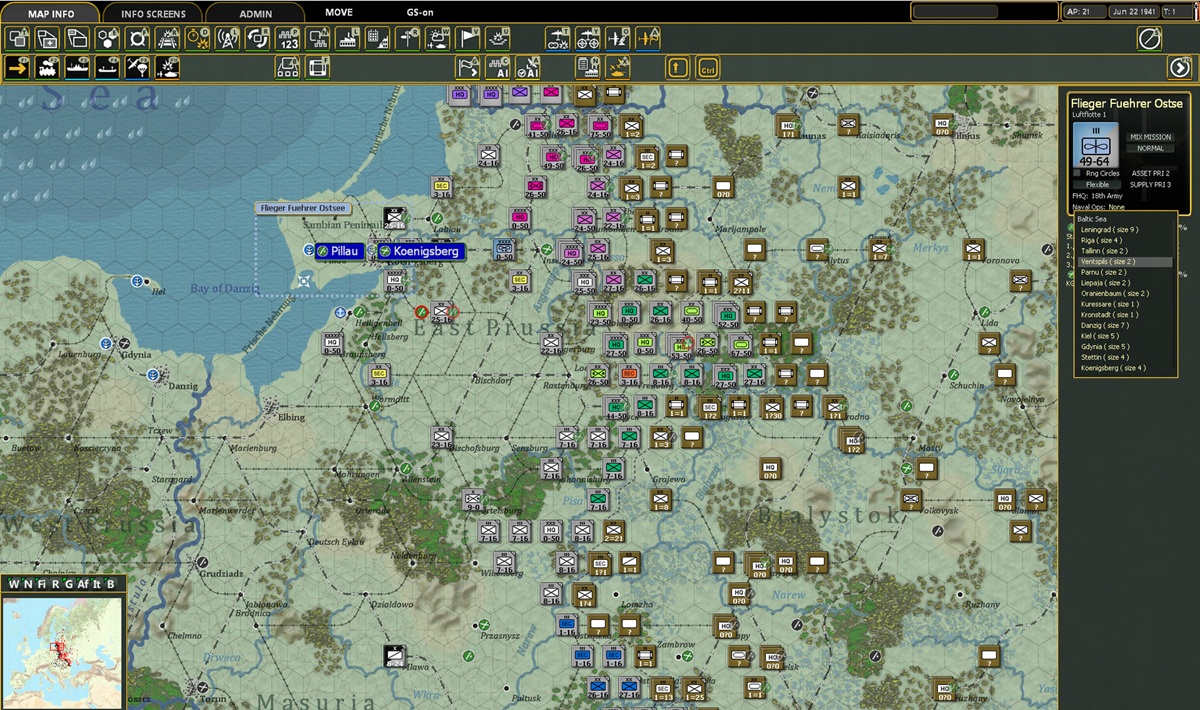
Widely considered the pinnacle of monstrously detailed grand strategy wargaming, this simulation of the WWII Eastern Front forces you to manage the entire logistics backbone of the German or Soviet war machine to depths you cannot even phantom in most titles. Hey, this is the granddaddy of wargaming for a reason. You don’t just abstractly supply troops. You must manage rail line conversion (due to differing Russian and European track gauges), depot capacities, and the physical wear and tear on your truck fleet. If you advance too quickly, your forward columns will completely starve as freight trains bottleneck hundreds of miles away.
Conclusion
That’s it, a smaller list than usual, but there’s so much you can do when it comes to this topic, and I could have done something a bit more extensive, but I would have been repeating myself non-stop, which doesn’t make a whole lot of sense. I hope you enjoyed, and subscribe to the website to keep up to date with the latest news, reviews, previews, and lists!
Support Strategy and Wargaming
I do what I do in Strategy and Wargaming because I love to do this, and I’m never going to stop. If you would like to support me with that, you can buy me a coffee for a dollar if you’re feeling generous. If you can’t, no worries, Strategy and Wargaming will always be free, and I’d love to have you around!

Leave a Reply