
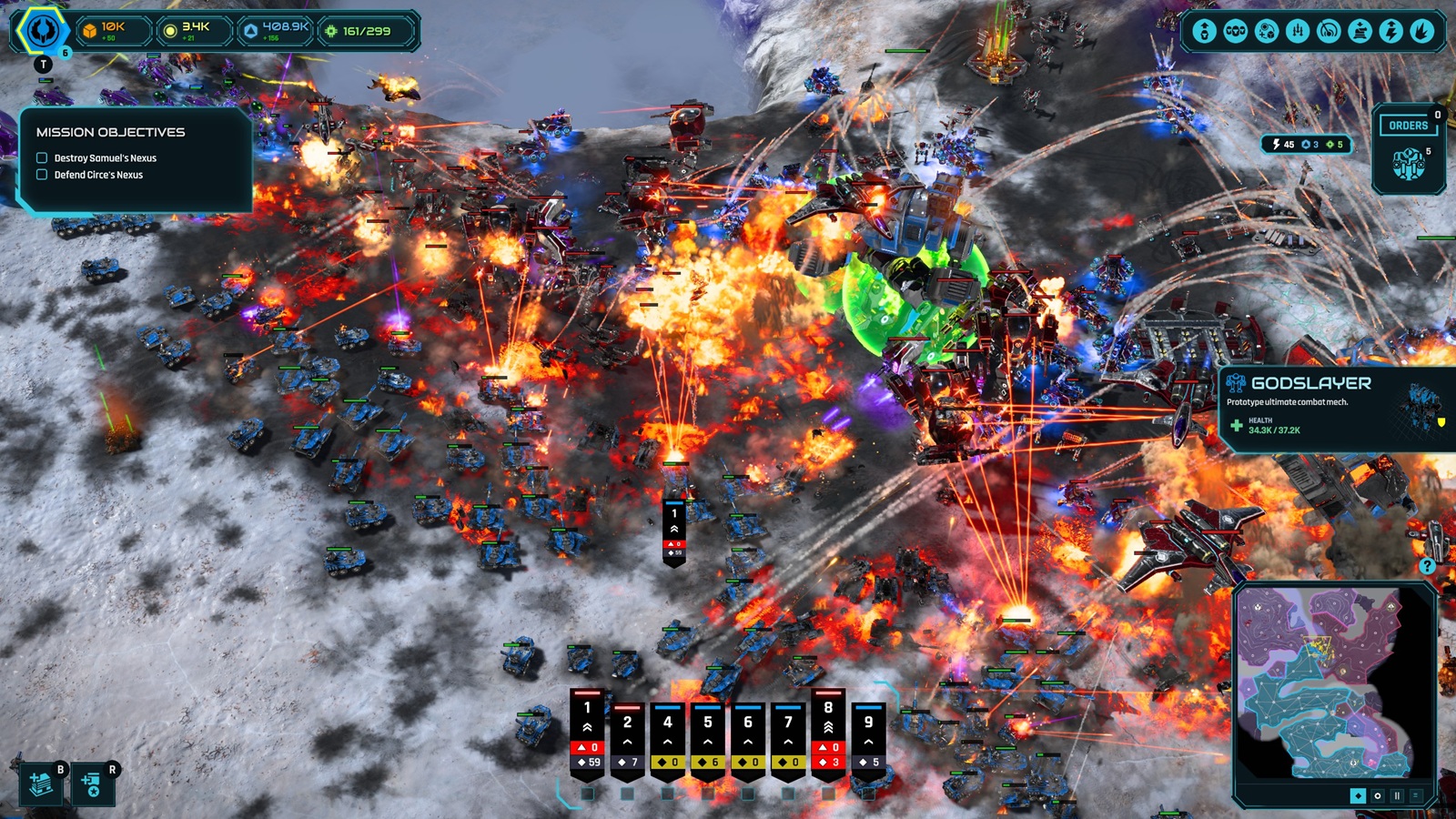
It’s hard to tell you how excited I was to play Ashes of the Singularity II. As someone who skipped Total Annihilation and Supreme Commander back in the day, I thought to myself that this would probably be the game I would finally pick up and use to experience the thrill of commanding hundreds of units on a massive scale.
On top of that, last year I also did quite a big interview with the team behind Ashes of the Singularity II, and I loved their bold approach to wanting to create something that’s memorable and different from the games that inspired them. In that interview, Brad Wardell mentioned that one of the most exciting things about the game was “Being able to actually command armies of soldiers (not squads, not divisions, armies) is something to behold. Especially since units don’t just disappear when they die”. So, what about Ashes of the Singularity II? Is it any good? Well, it’s complicated… At least for me.
You see, I think I am naturally inclined to enjoy more focused and small-scale experiences overall. Bring me an RTS game with a thousand units, and I would rather go back to Company of Heroes and manage a couple dozen. Have me play a strategic-level wargame, and I’ll be wishing for it to be operational. Give the said operational wargame I was just wishing for, and I’ll be playing it, wondering why I’m not playing something at the tactical level. Even in games like Total War, my favorite parts are battles. I am, and it’s no secret, a tactical-level kind of player. I like to see each of my individual soldiers move, take cover, chuck a grenade, fire, and all manner of soldiering. This doesn’t necessarily mean I don’t enjoy other scales. I love Hearts of Iron and Europa Universalis, and I have played every Total War game in existence except for two. All of this is to say that I’m not yet sure if my lack of enjoyment in some aspects of Ashes of the Singularity II is due to the game not being as good, or because I’m just not built to play it. I’ll explain those in due time.
This is not a review, and it’s more of a first impression. I’m currently on my 9th mission of the campaign, and I have played a couple of skirmishes to get a feel for the other factions, of which the game has 3. These are the United Earth Forces (the humans), the Post-Human Coalition (an affiliation of humans who integrated turinium and abandoned their physical bodies), and the Substrate (a sentient AI gone rogue).

All the missions I have played so far had me commanding the UEF against the PHC, which had decided that starting to occupy the Moon without any consent by the human governments of Earth. Humans are not having any of that, so a decision was made to start a massive whallop campaign against the PHC. What followed was a series of missions that gradually introduced new units and mechanics. Missions start small in scale and gradually become bigger and more complex, and they oscillate between different types of objectives, from offense to defense. It’s all very par for the course in RTS campaigns. So far, it has been an enjoyable experience I want to play more of. Now I want to see the narrative of the game unfold, because it has failed to captivate me, but just because looking at thousands of units go at it is rather fun.
One thing I want to praise Ashes of the Singularity II for is its weird army system, which, while it isn’t perfect by any means, is great for players who lack the high-level APM required to micromanage hundreds of units. In Ashes II, players build entire armies, and not just individual units. Each army can have up to 100 units in it (most units come in squads), and these armies can be composed of any mix you can think of. This means that instead of trying to set up your troops on the go, you can pre-plan what sort of composition you’ll need and let them spawn and then move them to battle. These compositions can be changed at any time by regrouping units using Ctrl + whatever number you wish to assign them to. This army feature is integral to the gameplay, despite the fact that you can also micro-manage individual squads or units if you so desire. These armies tend to fight somewhat competently, at least during the campaign. From my interview with the developers, they mentioned that the game would have a sort of sub-commander controlling these armies. I’m not sure if that’s the case, but your units certainly don’t attack the same target, and they’ll spread out their efforts. Not sure if they attack on a “what’s near to me” basis or if this is some sort of result of these officers deciding what they should prioritize. This way of controlling your armies means that most of the time gameplay is all about setting up a proper force composition and then maneuvering and watching things unfold. Battles are long and drawn out, and that’s something I think most RTS could do. This gives you enough time to reinforce, retreat, and adapt. More often than not, I was found with my pants down, having forgotten to bring AA, so I could instantly start putting a new force together of fighters and rush them into the battlefield.

The highlight of the battles is the massive units one can field, and being able to send a dozen of them into battle at once is really fantastic to just sit back and watch as they mow down everything else. When battles are going, Ashes of the Singularity II is super fun, and the rush of constantly trying to bring new units into the fray while the enemy does the same is exhilarating. If you’re the sort of player who loves interacting with things like cover, detailed lines of sight, and ambushes, then I don’t think Ashes of the Singularity II will do you a ton of favors. I have been flanked more than once, and I have devised encirclements, but this is a game about overpowering your enemies with numbers. I just don’t think it’s fair to call them doomstacks because there’s a ton of depth in the army composition and unit countering.
Graphically speaking, the game is a bit of a mixed bag for me. It doesn’t look bad, but to say that it looks good would be a lie. I think the best way to describe its graphics and art style is serviceable. My biggest issue is that everything looks a bit too flat. Let me try to explain what I mean. The unit models look good, but they feel like they’re lacking in animations and effects. A massive mech stopping around should be leaving dust clouds and leaving footsteps. As it stands, units look like they’re floating. A glorious, full-front mechanized assault should be accompanied by a flurry of effects as well. There are no crater hits, no ground damage. Units in fights also stand there shooting at one another, and it just looks like they’re bored. I get the whole readability thing, but as it stands, most of the similar units are already hard to distinguish from one another, so you might as well go full-on spectacular mode. There’s also a bit of a strange inconsistency when it comes to the quality of the units, because the PHC and the Substrate ones look a lot better designed than the human ones. The environments also feel strangely barren most of the time.

The same goes for the buildings in this game. While the units are well designed and some are exceptionally memorable, like the Titan M-7 and the Initiate, the buildings are really generic, especially the human ones. They all look so similar that I still find myself having to hover my mouse to see what they are. They could also benefit a lot from having some animations that are not just a couple of smoke puffs coming out every so often. What’s even stranger is that the buildings that you can use to recruit units are the ones that look the most similar to one another. A slight redesign to indicate what they are would really go a long way. Here’s another perfect example of what I mean about the game’s lacking a bit of liveliness. This is supposed to be a propulsion thruster sending a massive asteroid towards Earth. The only thing that’s animated is the flame. Everything else is static.

Again, I do understand that this is a game that’s supposed to be played at a massive scale, but this is a building you can see even when zoomed out.

As for performance, I’m playing this on a beefy rig, so I wasn’t expecting to have any problems with it, and for the most part, the game plays at a very stable FPS, even in major battles with hundreds of units and thousands of particle effects firing all at once. However, there were a couple of hiccups here and there when things got really intense, and FPS suddenly dropped for a bit, but the game quickly stabilized and went on as normal. I suppose most players with an average PC won’t be finding any issues, but I cannot vouch for that.
The fact that I want to see how the campaign unfolds and ends is probably a good enough endorsement that Ashes of the Singularity II is, at least, a good game. I do think it is. If you were to ask me if it’s going to win any awards and be a memorable experience that I’ll remember in a couple of years? Eh, probably not. However, I don’t think only games that are masterpieces are worth our time and money. Just this year, I have played 007: First Light and finally played Control, and I don’t think any of those are generational experiences, but they were good enough to keep me entertained for a couple of weekends. I think Ashes of the Singularity II is going to fall in that category.
Support Strategy and Wargaming
I do what I do in Strategy and Wargaming because I love to do this, and I’m never going to stop. If you would like to support me with that, you can buy me a coffee for a dollar if you’re feeling generous. If you can’t, no worries, Strategy and Wargaming will always be free, and I’d love to have you around!
Leave a Reply