
Total War: NAPOLEON

A fan favorite, for sure, Napoleon was the first Total War game to ditch the massive scale of the franchise in favor of a more focused and concise experience. I personally never found that much enjoyment in this smaller sort of spin-off, because the main “wow factor” is the game’s scale. With that being said, I would be lying if I didn’t say that I have enjoyed the game’s Iberian campaign, but that’s because it’s one of those rare moments when I get to play as my country, Portugal.
Total War: Empire

After Medieval 2 solidified Total War as a top-tier franchise in my eyes in the early 2000s, I can vividly recall my cousin and me being excited for what might come next. Excitement ensued when Total War: Empire was announced in 2007, and it came with a promise of a new historical period, bigger land battles, a world map extension, and the inclusion of naval combat. When it came out, the game was heavily criticized for its AI, but for me, it was an amazing experience right from the get-go.
Empire: Total War was the first time I have ever seen line battles actually play out as proper line battles, and not like the traditional unit clumps of most RTS games of back then. The scale was fantastic, and just big enough to feel epic, while also being able to run on my ageing PC at the time. The whole game felt a lot bigger, and that was exactly what I wanted back then. Even to this day, Empire is one of my favorite Total Wars to mod.
Total War: Attila

Well, the only reason Attila is this high on my list just comes down to a single factor: the 1212 AD mod. I don’t like the time period or the setting in which Attila takes place, no matter how hard I try to get into it. However, what I do enjoy a ton is the medieval timeframe, and man, does 1212AD deliver when it comes to spear slashing, sword-clashing, and armor bashing. It’s quite possibly the biggest mod available for Total War, with over 4000 unique units, each individually and uniquely modelled to reflect their real-life counterparts, and 50+ playable factions that include the major and minor powers from Western and Eastern Europe at the time, as well as nations from the Middle East. It’s a blast to recreate historical battles using the 1212AD mod, and that has been where I have spent most of my time with Total War during these last years.
Attila also used to have a fantastic Game of Thrones mod called The Seven Kingdoms, but that one disappeared from the spotlight several years ago. I do have a ton of screenshots from playing battles with that mod, and it fills me with hope and joy that there’s huge potential here, just waiting for Creative Assembly to eventually give the George RR Martin universe a go.
Total War: Rome

Here’s my number one entry! If you’ve been a reader on the website for a while, this shouldn’t really come as a big surprise to you. Total War: Rome was the first Total War game I had actually played, and the one I have played the longest (even to this day). It’s a game that did a lot of things right: It released at the exact right moment in my life when traditional RTS games were getting stale, and my love for History was growing. The History Channel was all the rage back then, with tons of Roman Empire documentaries; Gladiator was a major hit in 2000, and the Rome TV series arrived with a bang in 2005, right after Rome: Total War released in 2004. It was the perfect cultural zeitgeist.
But releasing a game at the pinnacle of cultural interest doesn’t make a classic. Rome: Total War nailed absolutely everything right about Roman warfare. Battles were massive, with tens of thousands of soldiers (with actual good graphics), fighting across massive maps, in battles that could last nearly an hour, with several back-and-forth tactical maneuvers, positioning, and flanking. Everything just clicked together in a way no other game ever managed to. I don’t want to go into a deep discussion on how formations behaved (with soldiers opening ranks to allow for troops to pass between them), and how experience influenced their capabilities in war, and how fights looked like they were real affairs, with real results from employing real tactics.
There are many reasons as to why Rome: Total War ranks at my number 1, but the main one is just that it’s my favorite Total War title, and the one I still enjoy playing the most in this day and age, even after decades have passed since it was first released. I also have a ton of fond memories that certainly influence its placement.
Total War: Warhammer II

Of all the Warhammer titles, the second one is the one I have enjoyed the most, and is one of the few games I own that I went out of my way to buy the special edition with a couple of extra cool tidbits like a metal case, exclusive stickers, and an Insider’s Guide that’s a beautiful little thing. It’s only when one breaks through the poverty line and is able to acquire some small semblance of nice things that you see what you’re really missing out on. But Warhammer II doesn’t stand out because of small trinkets and fancy marketing. No. It’s because it finally did away with the idea of having all factions playing similar roles but wearing different skins. For the first time since Rome, a Total War game felt like something fresh and special. Each of the four starting factions (Elves, Dark Elves, Lizardmen and Skaven) had different campaign mechanics- like the Skaven Under-Empire and the Geomantic Web of the Lizardmen- but it wasn’t limited to that. On the battlefield, each faction carried its own identity as well, with the Elves taking on the role of disciplined line-holders, their Dark counterparts acting up as hyper-aggressive damage dealers. The Lizardmen lines, in turn, were composed of durable heavy infantry, and the Skaven swarmed their enemies with hordes of cheap rats.
Warhammer 3 took this asymmetry even further by adding different end-games to all the factions, but the unique experience Warhammer 2 gave me has cemented itself as my favorite game in the series. I also enjoy its campaign a lot more than I do any of the other 2.
Total War: Shogun 2

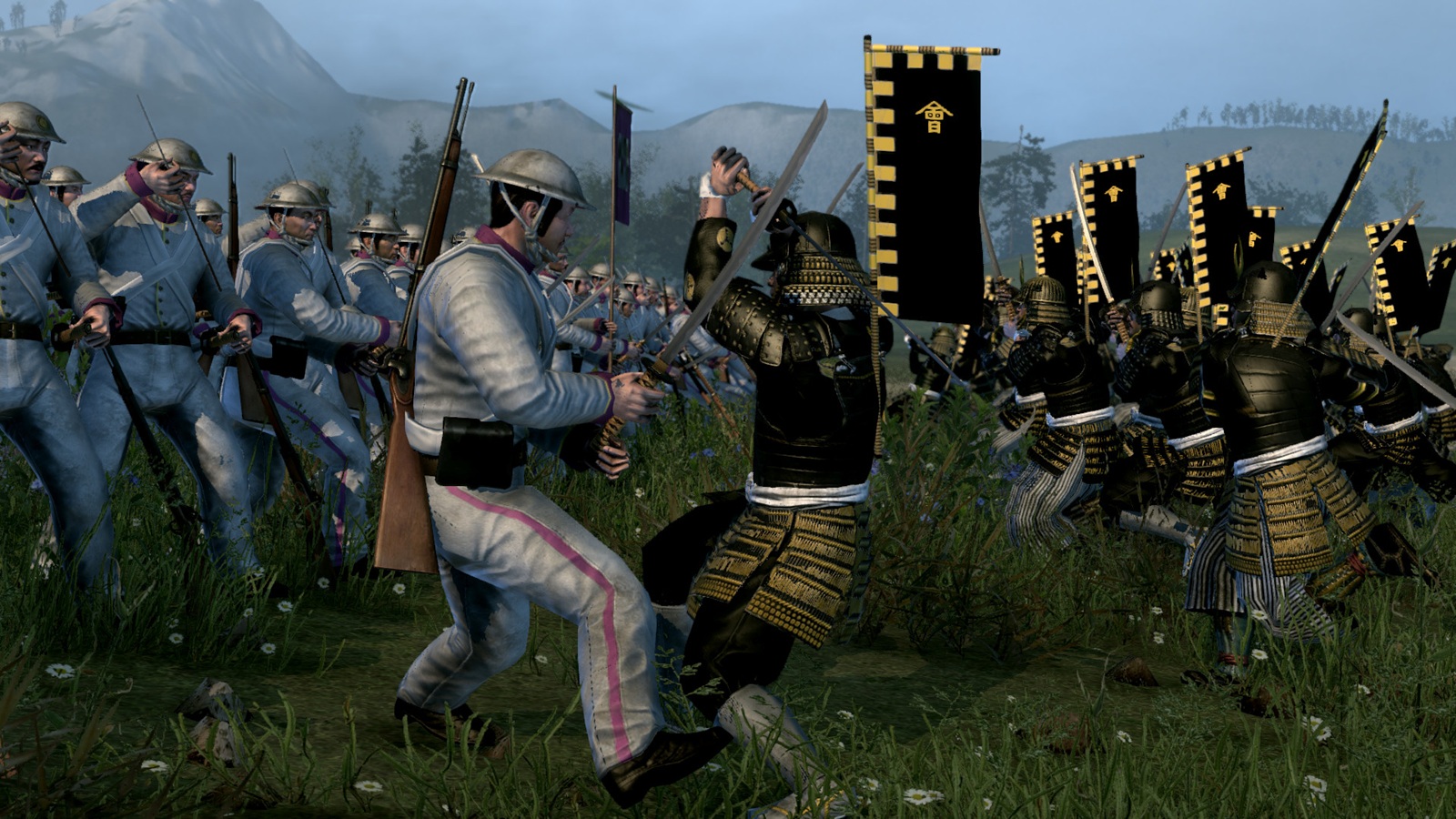
No matter which side of the Total War fence you sit on, everyone agrees with one thing: Total War: Shogun 2 is the best Total War game, and it’s still the high watermark of the franchise for flawless execution, polish, balance, historical reverence, and battle mechanics. Everything in this game came together to create the most perfect Total War experience possible. The clean, strategic battle mechanics offer a readable “rock-paper-scissors” kind of combat that makes historical sense; the game was released in a much better technical state than Empire. The AI itself played aggressively and was challenging, something that was also found lacking in Empire, and the game’ artstyle was realistic, stylized, and colorful, all at once, creating an amazing historical atmosphere that feels in equal terms serene and war-like.
No game is without its faults, and the game’s limited geography and the portrayal of the Sengoku Jidai period also meant that a lot of the factions played very similarly to each other on the battlefield. Fortunately, the necessary variation came with the amazing Rise of the Samurai and Fall of the Samurai DLCs that pivoted the game to the early medieval Japanese Period, and the late 19th-century Meiji-era Japan, respectively.
Support Strategy and Wargaming
I do what I do in Strategy and Wargaming because I love to do this, and I’m never going to stop. If you would like to support me with that, you can buy me a coffee for a dollar if you’re feeling generous. If you can’t, no worries, Strategy and Wargaming will always be free, and I’d love to have you around!


Leave a Reply