
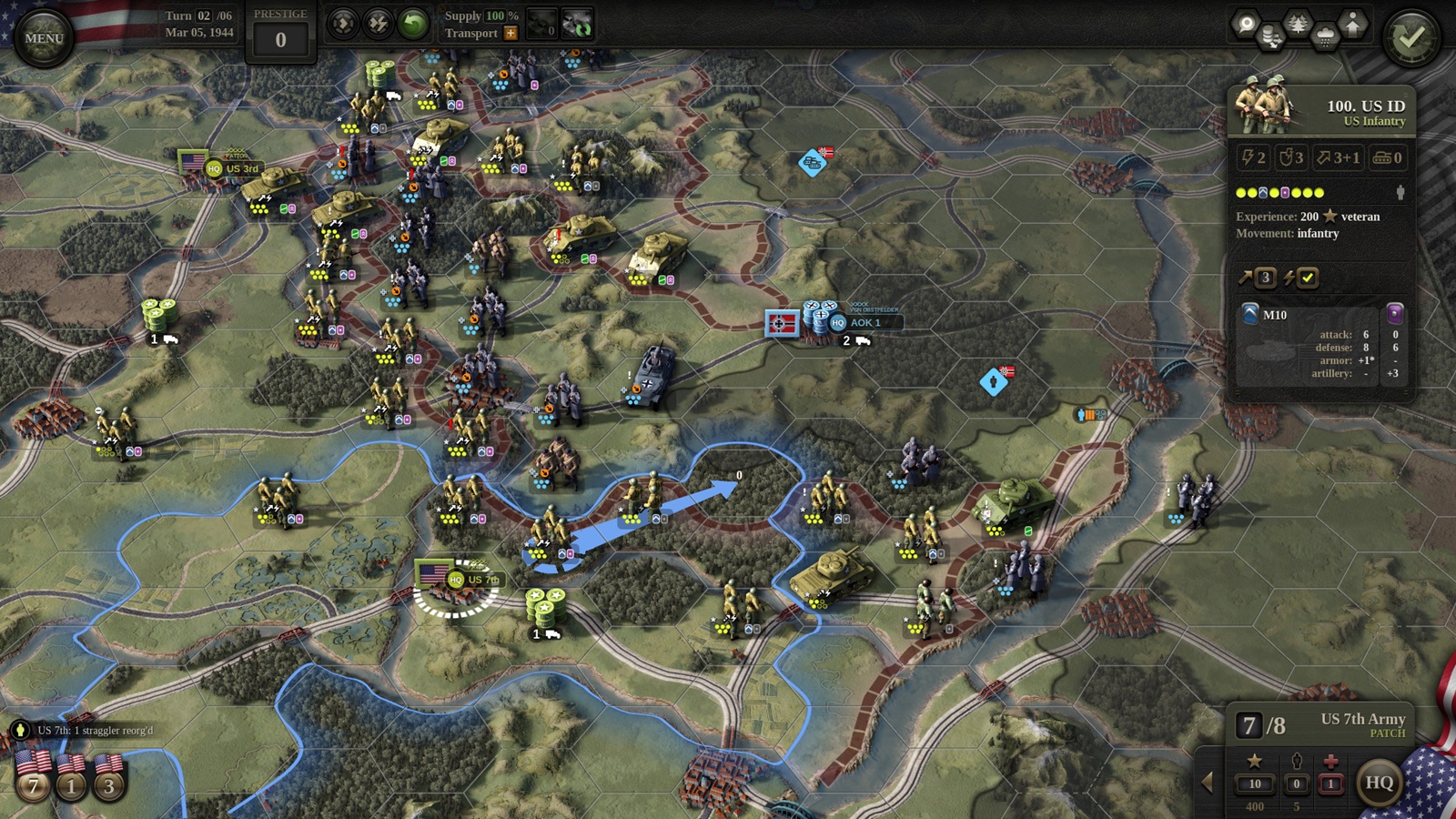
Conduct a Pre-Game “Staff Study”

While the previous three points we touched on are universal, this one might not apply to every game out there, but it’s still true to a substantial part of them. Officers and officer staff exist for a reason. They’re on the field or at HQs to command the action at their respective levels, and having a good officer core working alongside you can be quite a wild card to keep your eyes on. If the game you’re playing does simulate the existence of officers, do the same thing you learned how to do in relation to your troops.
Have a look at your command structure and see how it is implemented in the game. Does the game simulate the impact that officers have in combat? Say something like Burden of Command, Hearts of Iron IV, or the upcoming grand-tactical game from Slitherine called Battle of Command? If it does, then you must take a couple of minutes to assign the best officer for that specific unit. An officer whose career was spent conducting infantry tactics will have a widely different experience and traits (and stats, buffs, and debuffs) than one whose specialization is on logistics. Don’t just go through the motions. Take time and notes on how to optimize your troops. That will also help you with your very own storytelling and, hopefully, improve your enjoyment of the game.
Set “Micro-Objectives” Over The Duration Of The Game

So, after you’re completely familiarized with your troops and your officers leading them, it’s time to start putting a plan together. All titles will give you a grand objective to achieve, depending on the game’s scale and linearity, but most will just give you a briefing and point you in the direction of “go get that”, and then leave everything up to you. To achieve that major goal, it’s best to split it into smaller, easily achieved “micro-objectives”. Let’s take an example: You’re leading the Allied Invasion during D-Day, and it’s your job to lead the fight for the first couple of weeks, from coordinating the paratrooper drop of the night of the 6th of June, with the morning beach landings, as well as to move inwards to capture the important towns of Caen and Carentan, and capture the deep-water port of Cherbourg.
To achieve these major objectives is a massive undertaking, so you’ll be way better off breaking them into small chunks that are easily achievable and will give you an advantage going forward. Capture that hill, secure a bridge, holf that part of the line for a specific duration, these are small things that can also create their own mini-stories and sub-narratives and massively increase your enjoyment of the game, and this is especially true in massive wargames, when the grand-objective can seem so far away, that it can become discouraging, so doing this can be a great motivator and will certaintly help you moving forward as your work your way throught that massive 300-turn campaign.
Prioritize the Narrative Over the Win

Now that we have checked some of the more generic topics, let’s get into what I think might help improve your enjoyment of the wargames you’re playing (or getting into) even more.
Look, I know that we all want to win when playing. The feeling of overcoming a challenge is the thing that brings humans the most satisfaction. However, I’m a firm believer that wargames are better experienced when you try to keep yourself faithful to using real historical tactics and roleplaying a character (even if that’s yourself in that situation), instead of going all out to exploit game mechanics, abuse overpowered units, break the AI, and game design oversights just to win a scenario. I’m all about the experience of trying out tactics and strategies, and using these games as a canvas to experience History. Some of the best fun I have ever had while playing was when, instead of treating these titles as competitive ranking matches akin to League of Legends or Counter-Strike, my friends and I would agree on each one of us roleplaying a certain character, and then seeing how that path would take us. To be fair, some paths are doomed from the get-go. If one of you is fighting a desperate last stand, and the other’s victory is all but guaranteed, then all that’s left is to have as much fun as possible while doing so and laughing about it.
Even if you’re playing single-player, this situation is extremely common, especially in historical wargames, in scenarios where you’re fighting the historical losing side; sometimes, defeat is all but guaranteed due to circumstances completely out of your control. If you’re put in charge of the Japanese navy in 1944 against the United States, and given historically accurate units and limitations, do you really expect to win? Well, maybe if it’s a single battle, but the whole war? Not really, so the main goal becomes about seeing how long you can last. On a personal note, I do enjoy the challenge of playing the losing side, and the lack of stakes when you know you’ll eventually lose. It makes for a great learning experience as well. Focus on telling a story, and on accruing memorable moments out of all your gaming experiences. Remember: Fun is everything.

Leave a Reply