
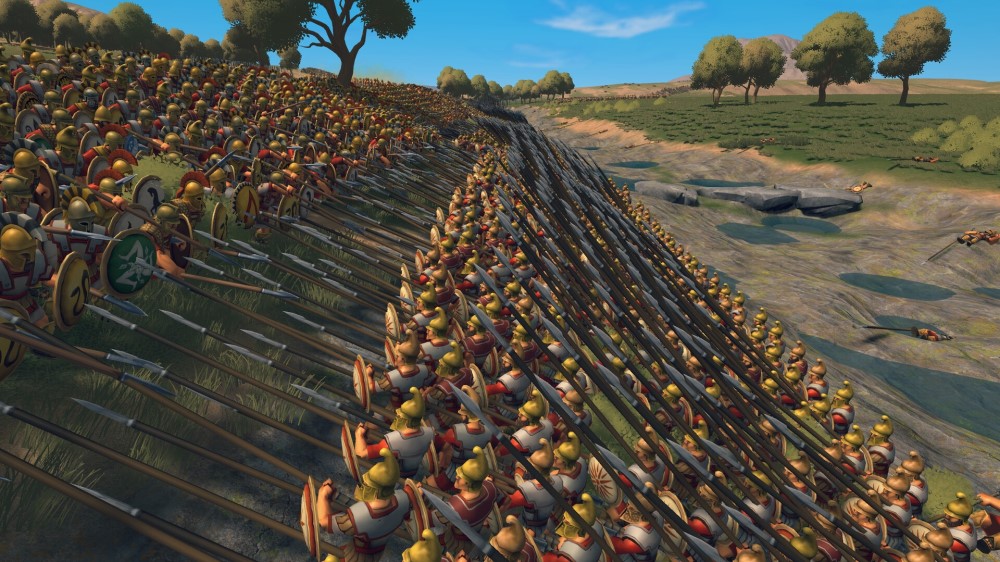
Have you heard about Strategos before? Assuming you have not, let me set the stage for you: It’s a real-time tactics wargame set in the period of Classical Antiquity, and it has set its sights on being the best option for gamers looking to simulate the large-scale battles of the time frame. The game’s going to feature over 120 factions, with the Hellenic Empires, the Persians and the Romans making an obvious appearance, manned by over 250 unique units.
MicroProse has announced today, that they’ll be publishing the game, and gave me the opportunity to interview the team behind this soon-to-be ambitious Total War alternative. I hope you enjoy it, and leave your comments down below if you think that Strategos is going to be able to go head-on against more established titles like Total War or Field of Glory II.
Can you, please, define Strategos for me? The Steam descriptions call it a “real-time tactics wargame”, but in every video I see, people comment on this being an alternative to Total War.
Given that the game has large formations of men moving around in real-time, the comparisons to Total War are inevitable but largely superficial. It’s only a Total-War-like in the sense that all first-person shooters are still Doom-likes. If a comparison must be made, the game is more like scaled-up, digital, real-time DBA or Field of Glory. The concentration is on major pitched battles, including specific historical reenactments, user-created skirmish scenarios, and campaigns that string battles together under a historical theme (e.g. Alexander’s campaigns).
Whenever I see the word “simulate”, my eyebrow furrows a bit. How is Strategos going to simulate ancient battles in ways other games haven’t done?
The command and control system (with couriers sent for orders beyond a certain distance) and semi-autonomous behaviour of units make Strategos feel more like a wargame and less arcadey than many real-time games. The commander must take into account that units will choose their own priority shooting and charge targets, evade and skirmish on their own recognizance, and can be goaded with shooting into wildly pursuing enemies. There is some degree of RNG to combat outcomes, so the player learns to keep a reserve to plug or exploit gaps and to move in a general for morale support where the line is faltering. Battle lines shift naturally, and based on unit type and discipline, some units can be ordered to intentionally hold position, fallback, or pushback to open up opportunities mid-line. Ongoing combats can also periodically shift into a mutual “passive” mode where the two sides, although still locked into melee, fall back for a rest during which combats are not resolved and they can rally (and they may hurl some missiles at each other if available), which is part of the “Pulse Model” of ancient warfare that inspired much of Strategos. The morale sim means that catastrophic chain routs can happen, and different levels of morale loss have distinct effects on a unit’s fighting ability, speed, brittleness, appearance, and so on. Hindrance from unit overlaps, elephants scaring horses, and terrain also reduce combat effectiveness. The army selection itself is also constrained so that armies must broadly resemble their historical counterparts in proportions of different unit types, rather than just being a points system free for all. In summary, the style of unit selection and the mechanics like autonomous behaviour, RNG, morale, and such are meant to provide a context for simulating historical battle outcomes between armies, rather than a game with arbitrarily balanced and predictable outcomes.
What kind of mechanics can we expect to see? Can you elaborate a bit on those you find most impactful on the battlefield?
Strategos brings deep tabletop-style wargaming mechanics to the digital real-time format, including unordered charges, priority shooting targets, line shifting, terrain disorder, multiple morale levels, chain routing from events like generals dying and elephants routing, and order delays via couriers. The multiple levels of morale mean it makes sense, for example, to disorder a unit first with shooting, and then charge in with impact-capable units once they are vulnerable (for example, when combining horse archers and cataphracts). The line-shifting and line-shift modes for some unit types help the player use some historical tactics like ordering a part of their line to fall back intentionally to open up enemy flanks (a tactic Hannibal, for example, was known for). Terrain disorder has a great impact on combat outcomes, unit speed, and concealment, and so determines where it’s best to deploy and move your soldiers through, whether and where it’s best to defend or attack and such (e.g. use rough terrain to blunt the charge of lancers or use trees to hinder pikemen and slow down cavalry, to give your medium foot a chance, or your ranged units more time to shoot). Generals’ units are powerful, but committing them means losing their instant reaction command radius while they are in combat, and risking their death, leading to cohesion checks and a permanent loss of command and control. The slower pace and use of couriers, as well as priority charge targets, mean the player must issue sweeping movement orders and general commands appropriate to a commander-in-chief, rather than focus on more gamey mechanics like manual kiting. Units are also broken up into fundamental types that determine how they do in terrain, whether they evade, how steady they are in ongoing combats, how long they pursue, and so on.
Antiquity is a very large period; are we going to be able to mix and mash armies as we want? Say, having the Persians fight against Iberian tribes?
Indeed, in addition to the specifically historical reenactment battles (Issos, Raphia, etc…) and campaigns, players can match any of over 100 armies against each other (optionally with allies) across different maps, with options for army sizes, difficulty, AI behaviour, deployment location and side, and so on. The game on release will cover almost 600 BC to almost 300 AD with these named eras:
Tullian: 578BC – 400BC
Camillan: 400BC – 275BC
Polybian: 275 BC – 105 BC
Marian: 105BC – 25BC
Principate: 25 BC – 284 AD
*The interview continues on the next page

Leave a Reply