
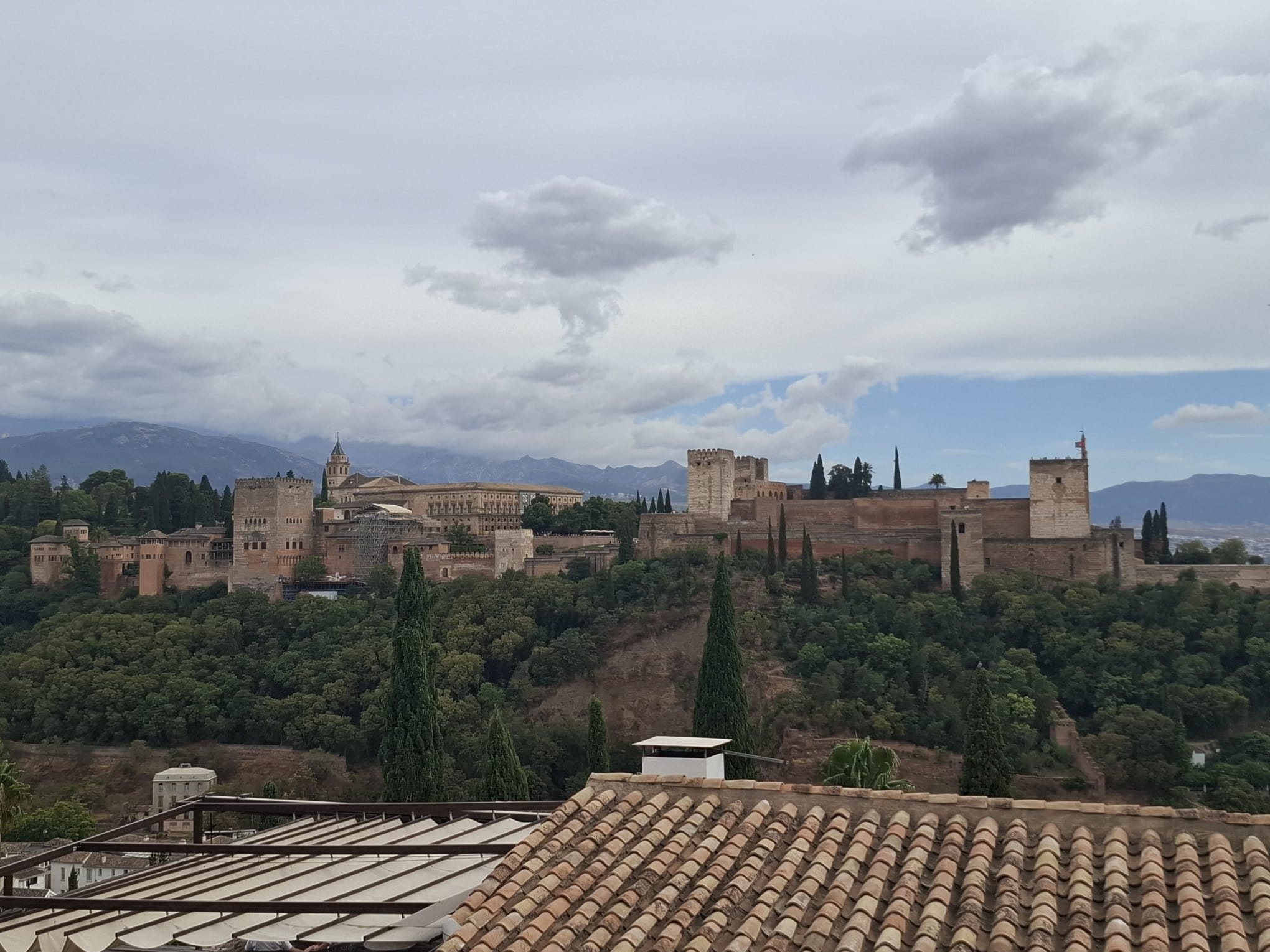
The History of Spain can be quite messy and confusing, but at least it’s beautiful. Case in point: The Palace of Alhambra. Now, while I was in Granada for this, getting tickets to visit the inside of the Palace in time for my brief stay was impossible, and while I was able to walk the woods around it, the best look I got at the beautiful 13th-century complex was from the Mirador de San Nicolas.
That meant going up the neighborhood of Albaicín, which keeps its medieval street plan from the 13th century very much intact:
The complex of the Alhambra was started by Muhammad I Ibn al-Ahmar, the first Nasrid emir and founder of the Emirate of Granada. How did Ibn al-Ahmar come to power? Well, he was allied with Fernando III of Castile, helping him with the Reconquista, and came to own the city in absentia when a revolt displaced the old ruler and announced him as the new one. He soon rushed to the city, made a treaty with Fernando, and started building the Alhambra. It was this treaty (and the other conflicts Castile was involved with) that consolidated the Peninsula’s political status until the late fifteenth century.
Fortunately, the Alhambra was surrendered without ever being attacked, so a lot of it is still intact, on the inside and out.
Some considerations on attacking something like this: I went up the woods around it (there are some very nice garders with some pathways), and let me tell you, that was not a pleasant time, and I’m fit. Running that in full gear would be impossible, no matter how conditioned you are. Laying out siege engines around it would be extremely complicated too, given how high the fortress is in relation to everything else.
The Palace and Fortress also inspired one of the most beautiful pieces of music ever written: Recuerdos de la Alhambra, meaning: Memories of the Alhambra, written by Francisco de Asis Tárrega, in the 19th century.
Also, fun story too, is that nobody really knows how Tárrega played the trémolo (the most famous aspect of this song, where the index, middle and ring finger play sequentially on the same string), because there are no records of him playing it. Some people play it very fast, like Narciso Yepes, others rather slowly, like Pablo Sainz-Villegas. Andrés Segovia, the most famous classical guitar player in history was supposed to meet with Tárrega for some lessons, but with Tárrega’s passing in 1909, the knowledge of how the trémolo should truly sound like was lost forever.
Next, I’ll let you know all about the famous Ronda Bridge, which might possibly be the most Dark Souls location I have ever visited in my whole life.
Support Strategy and Wargaming
I do what I do in Strategy and Wargaming because I love to do this, and I’m never going to stop. If you would like to support me with that, you can buy me a coffee for a dollar if you’re feeling generous. If you can’t, no worries, Strategy and Wargaming will always be free, and I’d love to have you around!

Leave a Reply