
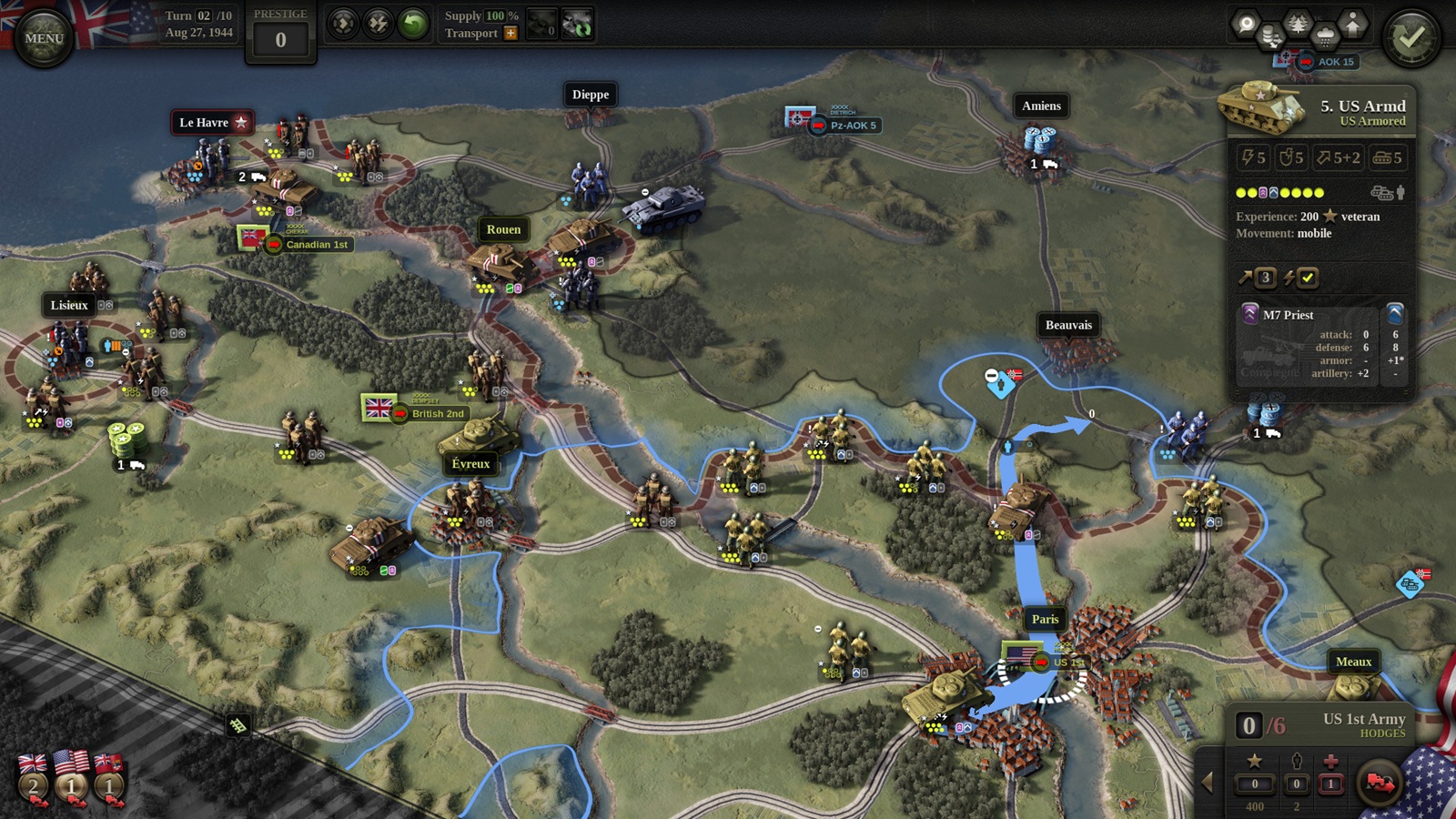
4 – Hearts of Iron IV

I know how contentious it can be to place Hearts of Iron IV in any wargaming list, but if you go by my definition of a wargame, it more than deserves its place in this list. Not just because of that, but because of the fact that it’s genuinely one of the best and most in-depth grand-strategy wargames of all time, managing to create a game that not only focuses on the military aspect of the Second World War, but also on the political, diplomatic, and even production side of the whole affair. I personally think the pivot towards equipment production, unit, and division customization added a level of strategy I don’t think I have ever seen another game attempt to do. Decisions about equipment, unit composition, and what’s possible become a lot more interesting when you have to take into account the fact that you might not have enough of everything to go around and have to prioritize, or acquire by trade or force.
3 – Command: Modern Operations
I don’t think there’s any possible argument to be made against the obvious fact that Command: Modern Operations is, by a very massive margin, the most complex and realistic depiction of modern-day combat available on the consumer market. It has the biggest equipment database in wargaming history, with almost all available weapon systems having been faithfully translated into the game. Despite its Everest-like learning curve, the integration with Tacview allows players to experience the simulation in 3D, transforming the endless options and menu navigations into something tangible and exciting. Command: Modern Operations is currently in use by several NATO countries as a training and wargaming tool, and it seems like there’s no competition on the horizon. Over 20 DLCs have been released since the game came out, with scenarios that range from historical actions, alternative “what-if”, and near-future possible conflicts.
2 – Unity of Command II

There are two wargaming series that open the genre to a whole new host of players, and are responsible for making wargames appear more accessible, and something that wasn’t stuck in the early 90s. Those titles are Battle Academy and Unity of Command. If the first Unity of Command was an innovation and an exercise in mechanical simplification without sacrificing depth, then Unity of Command II is an exercise in refinement and polish.
Built using a new 3D engine, Unity of Command 2 kept the beloved art style of the original, all the while keeping the same mechanical simplicity and a focus on juggling mobile and fast-paced warfare with your available logistics. Long gone are the days of trudging through endless menus to see if a node is, or is not supplied, or why a unit is cut off because of some obscure mechanic. It’s easy to pick and play, it has a tremendous amount of content, and it’s a wargame that won’t require you to dedicate half of your waking hours to learn it. No wonder it received widespread acclaim and praise from everyone, despite the fact that its scenarios are a bit too puzzly for my liking.


Leave a Reply