
I have spent the last six months or more reading books about the American Revolution, playing the old WDS Campaign 1776 title, and testing different versions of this new game. If you read my interview with the game designer, you would see the list of books I’ve studied, such as With Zeal and with Bayonets Only by Matthew Spring and The Glorious Cause: The American Revolution by Robert Middlekauff. I wanted to get to know the deep, nuanced way of warfare during the Revolution—the commonly used Brown Bess, the Grenadiers acting as the British “tank” force (much like a Space Marine in the Warhammer universe), and how the light infantry served as a precursor to the mobile infantry of 20th-century warfare.
Interviewing the game designer also allowed me to understand his scripting and victory condition choices, letting me get into the “nitty-gritty” of what is under the hood. I saw how he visited locations in South Carolina and Manhattan to tour the terrain as he designed the maps. No stone was left unturned in exploring the accuracy of this game. However, you may want to ask: how accessible and fun is it? At the end of the day, we play wargames not just to “cosplay,” but also to have a good time.
Gameplay
The gameplay follows the classic John Tiller style: easy to pick up and go. It requires slightly less clicking than earlier titles, as you can now right-click on a distant area rather than dragging units manually.
What makes it different from Campaign 1776? The answer is formations, which are the hallmark of 18th-century tactics. You have open order for two-rank loose units to enter woods without disruption, column march for faster travel, and extended lines for large units compared to retracted short-line formations. The designer also ensured that mobility differs based on the unit type and the specific year of the war; a unit in the 1780s fighting in the South may be more mobile than a unit fighting in Manhattan in 1776.

The game also features melee sub-phases that prevent the “blitzkrieg” exploit found in previous games. You can no longer have a few Grenadiers “chomping” through everyone in one turn. This also removes the need for too many phases, keeping the game more mobile for PBEM (Play by Email). Furthermore, unlike Campaign 1776, this game offers multiple scales, including company and battalion levels, ensuring this is more than just a simple update.
Scenarios and Campaigns
I manually counted about 147 scenarios and 4 campaigns. There might be a slight margin of error, but it is a massive amount of content. I’m not sure I’ll get through it all this decade—that is some serious bang for your buck. The designer told me that if the game sells well, he can continue making more in the near future. No other game on the market offers such a diverse set of Revolutionary War scenarios with this level of historical due diligence.

The campaigns include the 1777 Philadelphia Campaign, the Saratoga Campaign, and the Battle of Brandywine Creek. All can be played from both sides. You have the option of manually controlling every unit or using “Commander Control,” where the AI assists with certain units so you aren’t micromanaging everything. This gives you the feeling of a General issuing orders to subordinates. Some scenarios even offer strategic choices, such as a Concentrated Defense versus a Spread Defense.
AI In The Game
John Tiller/HPS games had a bad reputation for AI in the past, but WDS has been on a mission to make AI a priority. Do I see this in this title? I had many discussions about it with the company heads and the designer.
A perfect example is the Cowpens scenario. I know the designer, Mike, spent time visiting the site; it was a small-scale but brutal battle. I started in a misty cover of darkness around 6:00 AM. I couldn’t see much in front of me while playing as the British. Using cavalry to screen the field, I approached a victory area and saw skirmishers blocking my advance. Instead of acting like cannon fodder, they retracted. As the fog lifted and dusk broke, the Revolutionaries opened fire. I found myself trapped in the same historical predicament as LTC Tarleton.

Cowpens is a great testing ground for both AI and historical accuracy. In the original 1776 game, Tarleton’s troops were “A” quality and fresh. In Mike’s version, they are exhausted and vulnerable to Daniel Morgan’s energetic but unkempt troops. Tweaks like that show that Mike cares more about accuracy than perfectly balanced gameplay.
Sometimes you can bog down the AI just like in real life. During the Long Island scenario, I placed companies of militia as “speed bumps” in front of columns of professional Grenadiers and Henry Clinton’s best. I was able to harass and disrupt them until the turns ran out; even so, they bloodied every troop I had. They used flanking maneuvers and captured my artillery. Bedford Pass and Flatbush Pass were overrun by turn 12. After 15 turns, only the 11th Continental (with a “D” quality) seemed effective. While I could only chomp through their troops occasionally, their Grenadiers did so consistently. Tactically they were sound, but strategically defeated.
The Savage’s Old Fields – First Siege of Ninety Six scenario is perhaps the best showcase for AI dominance. Playing as the Revolutionaries under Major Andrew Williamson, I was hopelessly outmaneuvered and outmatched. Halfway through, I threw in the towel. Some gamers might dislike that, but others will salivate at the challenge.
As a reader of James L. Nelson’s With Fire and Sword, Bunker Hill was my final test for the AI. In the original Campaign 1776, the scenario only featured the Charlestown Peninsula. American Revolution shows the edge of Boston where the British garrison prepares for the invasion. There are also plenty of support ships for the British, which were absent in the original. While I missed the old supply carts for the “race against time” to resupply, the new version requires you to be much more careful with ammo, especially artillery rounds.
In this version, Howe still has a hard time pulling off his Pyrrhic victory. The AI fought tactically and captured an objective from my unguarded rear (a foolish mistake on my part). I tried to recapture it with 800 militiamen against 100 light infantry. I killed eight of their men and they killed two of mine, but afterward, all 800 of my men routed. That randomness felt authentic to militia performance. In the end, I defended Bunker Hill, inflicting 600 casualties while taking 200. It wasn’t easy; the Grenadiers were persistent and wouldn’t budge until I wiped them out completely.
Graphics and Sound
Compared to competitors like HexWar’s Saratoga and Hold the Line: The American Revolution/Rebels and Redcoats, or even the demo of The Glorious Cause and newer WDS Musket and Pike titles, this game has no equal.
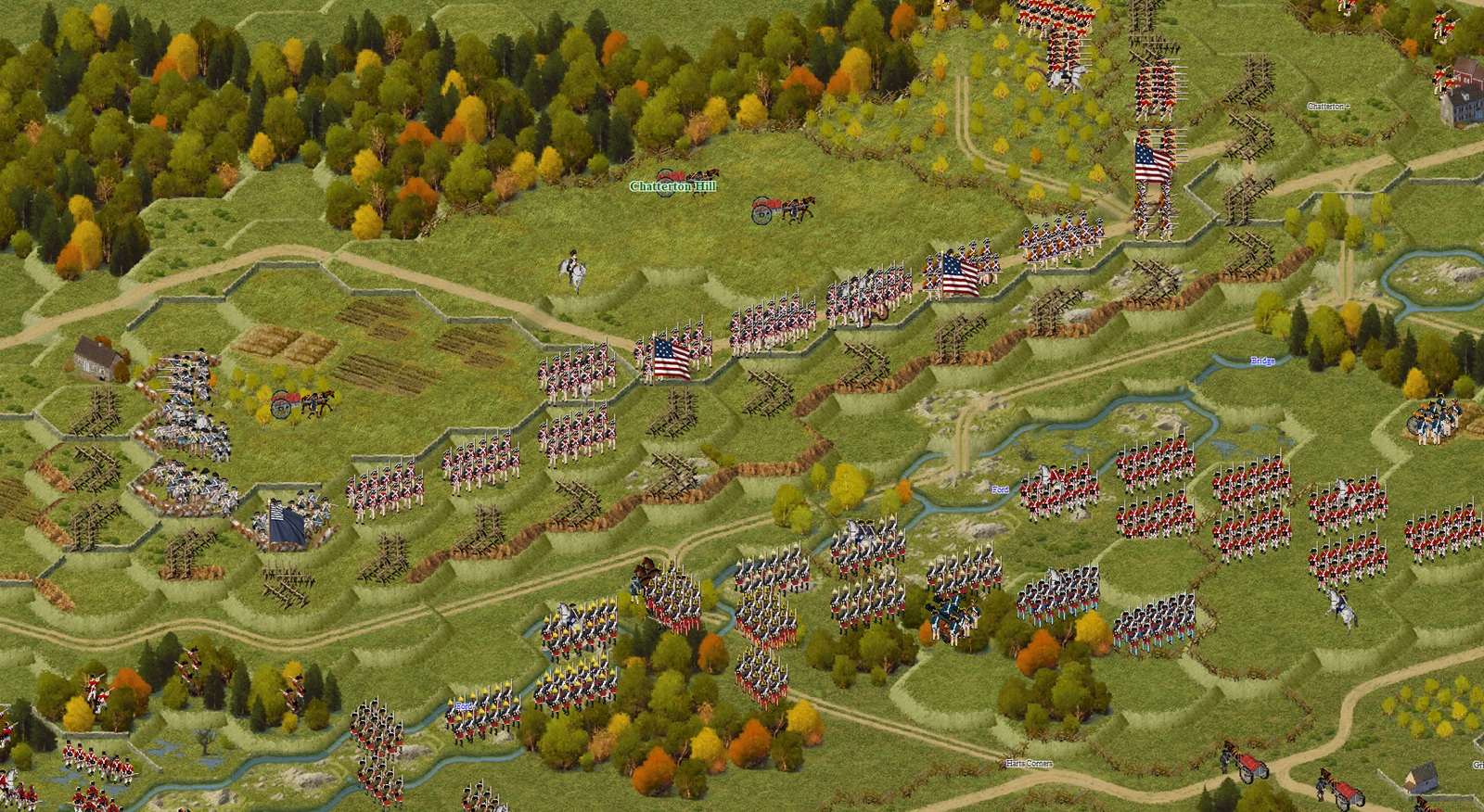
The unit art is fantastic and stays true to 18th-century aesthetics. Seeing portraits ranging from Daniel Morgan to Burgoyne feels like looking at beautiful little paintings. Let’s be real: most of us are into 18th and 19th-century warfare because we admire the “Dandy” element of the gentleman’s attire and the orchestral music of the era. Vast formations of armies show off their power by lining up on what looks like a pre-modern runway show. It displays discipline, fashion, and pageantry compared to what they considered the “inferior nations” of their adversaries.

If you don’t believe they were “Dandy men,” just read how Douglas Southall Freeman describes young George Washington’s passion for dancing, or learn about General Burgoyne’s plays, such as The Maid of the Oaks.

However, the American revolutionaries—like the Jacobite rebellion before them—are also portrayed as an army of “uncultured commoners” with folk music, which the game captures quite well. Hits like “God Save Our Thirteen States” and “Revolutionary Tea” pump up the rebel army as militiamen disrupt the runway show of the British formations. The art for each militia unit displays them as rough-and-tough outdoorsmen living on the fringe of civilization—a style personified in the American imagination by the likes of Daniel Boone. This is especially perfect for the Southern Campaigns.
While the 3D graphics are as good as ever, the 2D graphics are what truly impressed me. The map design is beautiful, with every hex full of color. I am not shortchanging the 3D graphics—they are WDS’s best offering yet, featuring 18th-century homes and a new engine for tree design that is superior to anything that came before—but most people know I usually prefer 3D graphics in a WDS game. The fact that I am amazed by and prefer the 2D view shows just how well the art has been executed.

The soundtrack is authentic to the period. There are plenty of tracks to keep you pumped for battle, as well as an option for battle sounds only if you find music distracting. The sound effects are glorious, from cannonballs blasting to melee units charging. To some, the graphics in this type of game might not seem immersive because there isn’t “AAAA” ray tracing or 500 FPS, but I assure you the sound makes up for any graphical kinks.
However, Some Minor Criticisms Still Exist
Victory/Defeat Art: I wish the endgame art was more glorious. After all the work on unit art and graphics, we only get flags and text. Campaign 1776 had epic paintings. To me, it’s like comparing the art of a vintage 1960s paperback to the polished computerized art of a 2010 fantasy novel.
Spoiled by 2D: This game makes other titles seem dull. It’s hard to go back to Seven Years War or Napoleonic titles and look at block counters. I’ve been spoiled by the 2D art in this title.
Missing Portraits: There is no unit portrait for Alexander Hamilton. No other figure has been popularized in recent history quite like him, thanks to Ron Chernow’s book and the musical.
These are tiny complaints, especially since I can see Henry Knox, Daniel Morgan, and the dynamic duo of Von Steuben and Lafayette. You can even command the great traitor Benedict Arnold at Saratoga. On the British side, you have the ever-flamboyant Burgoyne and Cornwallis (Mel Gibson’s infamous nemesis).
Final Score 10/10
WDS American Revolution is not just about the Revolution; it is a revolution in wargaming quality. With its focus on historical accuracy, epic sound, and beautiful artwork, it is a perfect anniversary gift to the founding of the United States.
Support Strategy and Wargaming
I do what I do in Strategy and Wargaming because I love to do this, and I’m never going to stop. If you would like to support me with that, you can buy me a coffee for a dollar if you’re feeling generous. If you can’t, no worries, Strategy and Wargaming will always be free, and I’d love to have you around!
Leave a Reply