
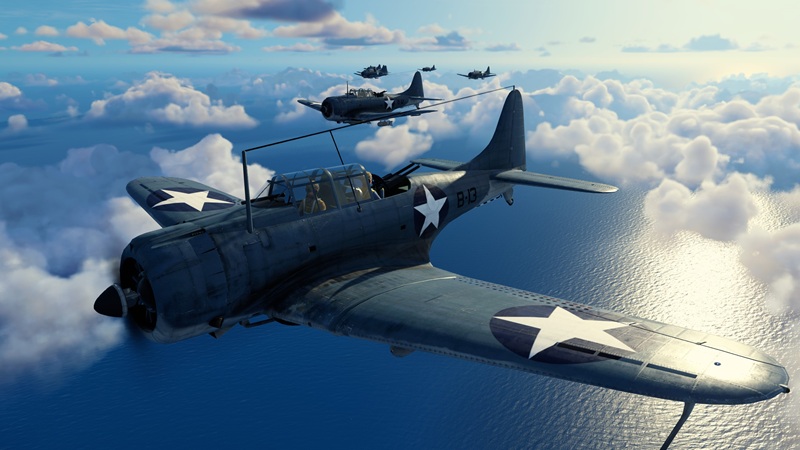
Of all the existing outlets out there, I’m 100% sure that I’m the guy who has covered Task Force Admiral the most: from small news segments going over its development, a massive 3-part interview with Amiral, the man behind the project, a look at its playable teaser, an exclusive demo preview, and recently I just picked up my aviator goggles once again to give its new demo a go. Now, it’s time to take the real thing for a spin across the Pacific.
What Is Task Force Admiral?
- Genre: Wargame | Historical | Naval Strategy
- Developer: Drydock Dreams Games
- Publisher: MicroProse Software
- Price: $35.99 | 30,59€ | £27.89
- Release Date: 27 January, 2026
- Reviewer: Nuno Marques (PC)
- Target Audience: Wargamers; Naval Wargamers; WW2 History Buffs, History buffs in general
- Final Score: 9/10
Task Force Admiral is a naval wargame set in the Pacific Theatre during World War 2 where players take on the role of a Task Force Commander (Rear-Admiral or Admiral), and lead and command several United States Navy Task Forces against the Imperial Japanese Navy in 1942. Task Force Admiral intends to be a one-to-one representation of those now-iconic naval engagements that shaped the course of History’s largest conflict and redefined the future of naval warfare. Each ship, each plane, and each bomb and torpedo is faithfully recreated in 3D, and battles happen in real-time (you can speed them up, of course), and players will spend their time plotting courses, setting up defensive perimeters, launching scouting parties, and preparing and launching strike parties.

In theory, all of this should be rather complicated. After all, you’re managing one or more strike forces at once, commanding thousands of men and hundreds of pieces of equipment that need to be properly equipped, serviced, and prepared for combat. One major plus for Task Force Admiral is how much it cuts down on the busy work, giving you the option of keeping things simple and oiled up for a very uncluttered gameplay experience. Using just simple commands of plotting, scouting, and setting up strike forces was enough for me win both of the existing historical battles: The Battle of the Coral Sea and Midway. Of course, if you wish, there are options to minutely control every aspect of the gameplay, and check each individual plane’s equipment and stats after an operation, but personally, the reason someone like me, who’s a not a huge naval History buff can enjoy Task Force Admiral is because it’s just so simple to pick up and play, even without any tutorials.
So, the question is, does my most anticipated wargame for 2026 deliver?
Great Fundamentals, But Thin In Content
I don’t think anyone can point at Task Force Admiral and claim that this isn’t the best recreation of World War 2 carrier combat around. From its detailed recreation of ships, planes, equipment, formation, and tactics, Task Force Admiral is an obvious labor of love that was fortunately paired up with a team that’s as competent as they are passionate for the subject matter. I wasn’t sure if the game had a sort of physics engine supporting its air combat, so I emailed the devs, and they have confirmed that yes, there’s a flight engine in Task Force Admiral. The way planes behave, as they gain momentum when diving and lose speed when climbing, they act too dynamically to feel like premade animations. In fact, during the previous demo, from last year, when their wing tips touched, I saw a plane stumble, recover, and avoid crashing, which was pretty damn impressive to see. This instantly sets Task Force Admiral apart and grants its air aspect a layer of dynamism and unpredictability that no other title can match.

However, and with all of that praised being laid out, I think Task Force Admiral is a great game in its own right, and will eventually be the ultimate naval combat experience set in World War 2, but at the moment there are two major caveats I think prospecting buyers should take into account before pulling the trigger: The first one is the lack of any tutorials. Now, the game is easy enough to pick up and play if you understand the fundamentals of carrier combat, but if you’re the kind of player who’s looking to start your journey here, you might struggle a bit. Not because of the UI (which is easy enough as is), but because the game assumes you already know how these operations play out, and expect you to play your part in it.
The second biggest issue at the moment is the overall lack of missions, with just 4 operations available to take part in (the aforementioned Coral Sea and Midway battles), two of which are historical, and two are hypothetical scenarios. On the surface, this would be a major hit for any game’s longevity, but I don’t consider that to be the case here, and that’s because of the game’s dynamic mechanics and how you can essentially replay the same battles over and over again and still come up with different results and need to adapt on the fly. In fact, I have replayed the Coral Sea battle several times and attempted to do things differently every time to see how well I would fare. I do think it’s fair to say that each of the 4 available battles contains at least some 5 to 10 hours each before you start to get bored with them.

At least, the game launched with a battle generator, but its options are limited and do not extend beyond the number of task forces available, the starting location, and pilot skill. So, if you’re like me and wanted to try out a naval battle without any planes to see how it went, you won’t be able to, at least for now. I’m not privy to what plans there are for the battle generator, but it’s my hope that it’s a lot more detailed than it currently is, and would resemble something like the one in Sea Power: Naval Combat In The Missile Age, which allows for an extreme degree of granularity and creativity.
Circling back to the game’s mechanics, orders can be issued with just a few clicks. Essentially, just boot up the 2D map, pick what sort of option you want to see happen, and the order details pop up. Want to search for the enemy forces? Pick a search, adjust the direction and length of the search cone, choose how many planes will take part, decide on a departing time, if you want them to shadow targets they might find, and send them out. Simple as that. As for striking sorties, the logic is pretty much the same: Pick a target, choose how many of each plane type should partake in the operation, choose a time, and let them fly into the vast Pacific expanse. Weirdly enough, I can’t seem to find an option to just send fighters after a suspected enemy strike force while they’re on route. Maybe I’m missing something, or maybe that just wasn’t a thing in the tactical sense (as I said, I’m not a naval History buff), and the game is mirroring that, but it’s just weird to not have that option. You must always have a bomber with your fighters to send a strike party out, so what you can do is pick a target, choose 20 fighters and 1 bomber, and let them go. Again, maybe I’m missing some option.

You aren’t defenseless against enemy striking forces, as one of the first things you should do is to establish a defensive perimeter around your task force, and in the case of an imminent strike, to scramble all your fighters, and they’ll autonomously go and engage the enemy. Players can also choose priority targets for those, and the ones that truly love to tweak every nook and cranny can even change the placement of their vessels to fit their own needs and strategies. My point is, there’s a lot you can play around with, if you so desire, but for the ones that just want to start a battle, Task Force Admiral allows for that, and proudly joins other games that favor automation in favor of laborious busy work, like Distant Worlds 2, and more recently, Europa Universalis 5.
Tally Ho! The Air Combat In Task Force Admiral
We’ve spent enough time discussing the fundamentals of TFA, but how’s the action? Well, once your planes are up in the air, they’ll automatically form up and move to strike the target you have assigned to them. The whole process is as realistic as it would have been in real life, with dozens of planes circling overhead, your ships waiting for everyone to get up in the air and prepare to climb. Fighters will actively protect your dive-bombers by spreading out to strike at enemy fighters, or will try to engage enemy bombers if no fighters are available. Again, remember that all of this is done with no input from the player. Technically, you can take direct control of a plane, but it’s a bit wonky at the moment, and totally unnecessary.
Dogfights can go on for quite a while, and planes maneuver to try and actively get an advantageous position on their adversaries, and sometimes they end abruptly, with a well-placed shot taking out the plane. Overall, the whole thing comes together nicely, and while I cannot opine on how realistic the maneuvers being made are, they look pretty legit, and aside from the random crashes into each other I saw during the demo, I haven’t seen anything like that in this final version.

Dive-bombers and torpedo-bombers also behave as one might expect, attacking in packs to try and overwhelm the enemy air defenses, and seeing a torpedo-bomber nearly skimming across the surface of the water as it lines up its shot is really exciting and damn cool to look at. The battles always seem so busy; it’s really a cool sight.
Also, speaking of striking forces and bombers, I have seen plenty of things that make me believe the AI isn’t just zooming into a location and target, and then bombing it. In my latest attempt at Midway, the cloud cover was so thick that from my plane’s perspective, they couldn’t spot the enemy ships that were right below them, until some clouds opened up, and only then did my strike force dive to engage the enemy carrier, and successfully bomb it, as you can see in the image below. I’m not sure if this was just a coincidence, but it led me to believe that clouds and cloud cover are far more than a visual thing. If you have similar experiences, please do share.

Awesome Looking Naval Wargame
It’s very often that I read online people claiming that “graphics don’t matter” in strategy games and wargames, and while I can simpathize with that sentiment, and to some extent, even agree with it, Task Force Admiral is the clear proof that good graphics do, in fact, matter, and do a lot of heavy lifting into making a game more accessible by removing abstraction and overall just making things look and feel a lot more exciting than just having some chits on a board moving around.

Task Force Admiral joins the likes of Sea Power: Naval Combat in the Missile Age, and Graviteam Tactics: Mius Front in the pantheon of the best-looking wargames of all time. Unit models look as sharp as they come, textures are detailed, and they use authentic colour schemes. Effects like explosions, smoke, bullet trails, and water splashes have that 3D look that makes them so satisfying to watch. Ocean waters and skies look extremely good, too. The only part of the game that’s not up to par, in my opinion, is the ground terrain, and that’s especially visible in the Midway map. The island lacks the detail the rest of the game has, but given that Task Force Admiral is entering Early Access and not coming out of it, I hope this will be worked on in the future. One thing that might be important to mention is the lack of any human and subsequent movement on board the ships at the moment, but it was the 45,000 dollars stretch goal and 130,000 dollars, respectively, of Task Force Admiral’s Kickstarter campaign, so it’s going to be added, eventually.
As for sound, the historical missions have voice acting for the briefings, so that’s nice to see, especially given the fact that the guy doing the voice attempts to sound like he’s from the 1940s, with that overly excited, yet serious voice. The rest is exactly what one might expect: the crashing of waves, the rumbling of engines, and the explosion of ordnance. It’s all very good, overall.

This graphical fidelity is even more important when a game wants to have as little abstraction as possible, making everything immediately apparent and providing instant feedback to the player on a visual level, instead of just relying on pop-up messages. Task Force Admiral is a complex game, with a lot of moving parts, and the user interface does a lot to make these moving parts easy to read and understand, but the heavy lifting is made in conjunction with the 3D. It’s one thing to send out some scouts and then receive a message saying they were dispatched, and it’s a whole other experience seeing the aircraft deck coming to life as the planes get moved around to open up space for the launch of said scouts. The same can be said for air combat, as the experience between receiving a pop-up message saying the air combat has been resolved and these and that losses were the result, and it’s a completely different feeling from watching that combat being resolved in real-time, and seeing every individual plane fighting or dive-bombing.

This graphical prowess also means that a somewhat beefy rig is needed to make the most out of it and have the smoothest experience possible. While my 8-year-old machine could run it somewhat decently, with just a couple of stutters here and there, now that I’m running the game on a substantially more powerful PC, the experience is unmatched in terms of smoothness and spectacle. Make sure you see the minimum available specs before buying it.
Final Score 9/10
If you’ve been a reader of Strategy and Wargaming for a while, you’re probably familiar with my philosophy of just reviewing games that I enjoy, because life is too short to spend time playing titles that one does not fancy. My review score reflects the present quality of the Task Force Admiral experience, when taking into account the detail, the true-to-life recreation of carrier combat, and the love and passion poured into the game. With that in isolation, the game is a solid 9 in my book. As a full purchase, with its limited content and lack of tutorials, I would give it a 7 or an 8 out of 10, but no other naval wargame made me want to stop what I was doing to go and play it as TFA did.
In all fairness, aside from what I have already mentioned in terms of content, there’s only one other real criticism I can point out to Task Force Admiral, and that’s the fact that the game can become quite repetitive, and the gameplay loop won’t change a lot during your time with the game. And even that can be hard to parse has true criticism, because the repetitive tasks of navigating your fleet, setting up patrols, defensive perimeters, and deciding when to launch your strikes can wear their novelty after a while, but that’s just the nature of WW2 carrier operations. If you’re a massive history buff who’s looking to really sink its teeth into this, I don’t think this problem will get to you anytime soon.
In the end, Task Force Admiral comes across as a massive labor of love, where the unmatched dedication to historical authenticity of its creator was paired with a technical team that’s equally as talented. The final result is the best foundation for World War 2 carrier battles we have seen to date. I’m excited for the future of Task Force Admiral. I expect great things from them.
Support Strategy and Wargaming
I do what I do in Strategy and Wargaming because I love to do this, and I’m never going to stop. If you would like to support me with that, you can buy me a coffee for a dollar if you’re feeling generous. If you can’t, no worries, Strategy and Wargaming will always be free, and I’d love to have you around!

Leave a Reply to DougCancel reply