

I have a saying that the secret to living a happy life is keeping your expectations low, and I went into Grit and Valor – 1949 with low expectations, even to the point that I wasn’t even considering covering it for Strategy and Wargaming. I’m glad I did, and not because I found some genre-defining gem, or because it completely blew me away, but because Grit and Valor – 1949 is comfort food. It’s the kind of game that’s good, but not great, something you can boot up, play a couple of rounds and move on with your day, and feel good about it. Sometimes that’s good enough.
- Genre: Real-Time Strategy & Roguelite
- Developer: Milky Tea Studios
- Publisher: Megabit Publishing
- Release Date: 26th March, 2025
- Price: $15.99/ 15,99€/ £13.59
- Buy at: Steam
- Reviewed On: AMD Ryzen 7 2700X 3.70 GHz, 16GB RAM, NVIDIA GTX 2080
Let me set the stage for you: The Axis forces managed to create mechs, bringing the allied nations on European soil to their knees. As members of the resistance, you and a couple other brave souls are the last hope for a free Europe. The resistance has managed to capture a few of these Axis wonder weapons and to turn them back on their creators: it’s up to you and a team of brave pilots to take an EMP into the earth of New Germany and bring a stop to their dictatorial mechanized rampage. This, however, won’t be easy. You’ll fail. Time and time again. But every time you try, you’ll get better, and unlock new mechs, new technology, and new upgrades.
That’s right, Grit and Valor – 1949 is a Real-Time Strategy game with a roguelite twist to it. If you know anything about me, I really enjoy playing roguelites, particularly those that have meta-progression, as the feeling of constantly getting better is something that really tickles my monkey brain the right way. The game is divided into two halves, the first is the real-time strategy tactical battles where you take your mechs to fight the Axis forces and to complete mission objectives. That’s where you spent around 90% of your time, jumping from mission to mission. The other 10% you’ll be spending on your base, working on unlocking new mechs, equipping them, training and improving your pilot’s skills, and researching new stuff to play around with. As you complete missions you’ll accrue several different currencies which can be used for aforementioned purposes. It’s a cookie-cutter system if you play other rogue-lite titles with meta-progressions, and it’s very simple and straightforward. If you have the currency, things are instantly unlocked, so there’s no time delay for new stuff to “arrive” or be “produced”. Did you manage to get 3 blueprints? You can unlock a new mech, equip it and take it to your next attempt. I like this. It makes things direct and respects player time. Pick 3 mechs (plus your command vehicle), and you’re ready to begin.
The game has several campaign trails, starting in Britain and ending up in New Germany, and at the end of each of these trails comes a unique boss. Each one of the campaigns also comes with its own map design. Speaking of which, one thing I’m not sure yet, is if the maps are randomly generated or not, but I could swear that they are not, or if they are, the variations are very small amongst them, and you can immediately figure out if you’ve played on that map before. While this isn’t bad, per se, I also think that after a while it can get a bit repetitive, and I specifically remember playing the same Scandinavian map in every campaign.
As soon as you enter the map, you’re tasked with doing just two things: hold off against the enemy’s four waves of assault, and complete an optional objective which may vary from ferrying fuel from one location to another, defending a specific structure, or destroying something. Fulfilling these secondary objectives is the thing that offers some dynamism to the mission because these are usually scattered around the map, forcing you to constantly navigate between positions, establish new defensive locations, and protect the mechs working on that objective. I would even dare say that it’s in fact these secondary objectives that spell the pace of every map, and they’re the thing that makes you adapt your strategy, making you more or less aggressive depending on what you’re tasked with achieving. Mind that you can still win every mission without completing these secondary goals, but you’ll end up skipping on a lot of currency. Also, despite this being a real-time strategy game, Grit and Valor – 1949 has a pause so that slower players (like myself) can make decisions and reposition units without the constant stress of managing a lot of stuff at once.
You press “Start Battle” and how do things unfold, after all? How do the mechanics hold up? Well, I have to say that while there are some interesting strategic conundrums to deal with, this is not on the level of something like Into the Breach. The combat is based on a rock-paper-scissors counter system, but you replace those with bullets, flames and explosives, and each one of the first deals increased damage to the second, the second deals more damage to the third, and the whole thing goes full circle. I’m not a fan of these kinds of systems because they immediately morph your approach from creating your own strategies into this weird sort of matching the right pieces, kind of gameplay. Fortunately, this is shaken up a bit by things like cover and weapon distance. Each one of your mech weapons has a specific distance it can fire at. So you can sort of avoid limiting yourself to the rock-paper-scissors style of unit matching by employing good positioning, but of course, following the formula will still have you deal more, and receive less damage.
This would all be very generic if it were not for the random upgrading system: prior to the start of every enemy wave, a friendly care package is dropped somewhere on the map. Pick it up and you’ll be rewarded with 3 random upgrades to choose from, these upgrades come in a variety of formats and rarities. They can range from regular to legendary in rarity (imagine something like Hearthstone), and their impact on the gameplay of your mechs can be things like simple flat stats or percentage-based boosts to damage, health, critical strike chance, etc., to things like increasing your unit attack range, adding armour, adding status effects and a lot more. I believe this to be the most engaging system of the game, and the core part of what makes Grit and Valor – 1949 worth playing: it’s starting a campaign with your basic mechs and not knowing if you’re going to end up with a ridiculously overpowered team, or a pile of mechanized junk. As your campaign progresses, it’s up to you to make the most of the cards you’re given (quite literally) and decide if you’re going to focus on creating the biggest monstrosity Europe has ever seen, or if you’re going for a more balanced team composition, with every mech being equally strong. If you’re into deck-building games like Balatro, Slay the Spire and Fights in Tight Spaces, you’ll love this one too.
The enemies fight with pretty much the same weapons as you do (remember that you’re using stolen mechs), but they’re compliments with more traditional troops like tanks, infantry, light vehicles, and air support. They’re not necessarily smart, but given that this is more of a horde-like game, they don’t have to be, as their strength lies in their numbers, not in their tactical cunning.
I don’t want to spoil the process of unlocking new stuff, but rest assured there are an interesting number of mechs to unlock, and each one plays differently from the others, so that’s a great thing. If I had a complaint about the way mech customization works would be the fact that the components you use to modify them are not that interesting. Well, at least most of them are not, and they come down to being just basic stat increases. I would have loved to see some overpowered and wild things like doubling the number of weapons a mech has but it is 90% slower, or having no weapons but being able to deploy active abilities a lot more often with no limits (yes, there are active abilities, each pilot has one, and they’re things like bombardments, mines, repairs, and other things of the sort).
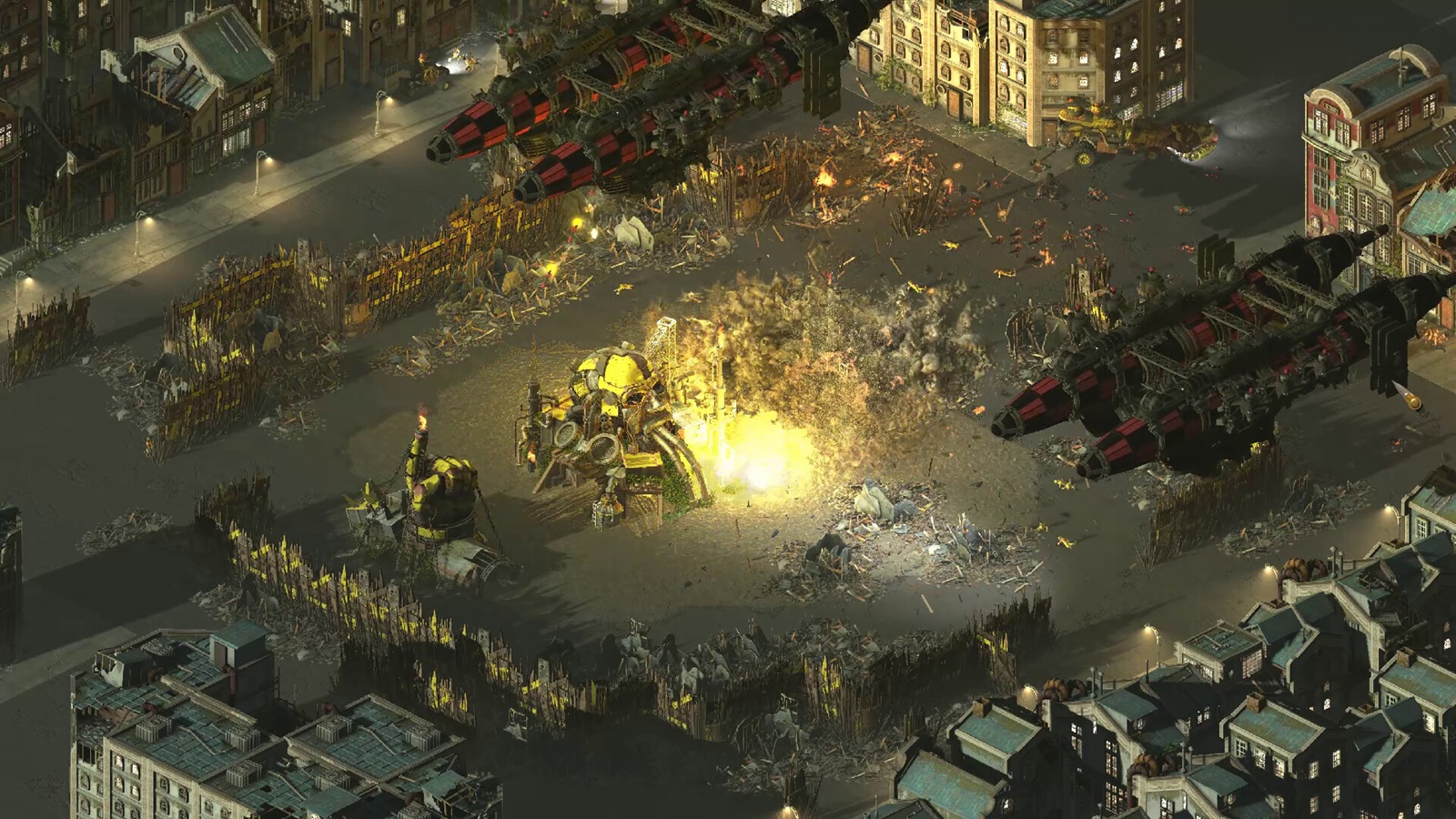
Graphically I enjoy the minimalistic direction that Grit and Valor took, as it fits perfectly with the theme of the game. Maps are easy to navigate and everything can be spotted at a glance, from friendly mechs, to cover, interactable objects, rewards, and enemies. Everything is distinct, a true masterclass of visual simplification. Another thing I enjoy is the mech design, which manages to look silly and serious at the same time, the exaggerated proportions of some of them paired up with high-quality textures and detailed mech animations. I also love the over-the-top design of the Evil Axis forces occupying Europe, as it’s exactly the kind of thing I could see come out of a Saturday morning cartoon, and every villain looks like an offshoot of Bison, from Street Fighter. All things considered, Grit & Valor is quite the minimalistic looker. The UI is equally simple and easy to understand, and everything is available on a single screen like it should be for a game of this nature. The sound design and music are serviceable, as there’s nothing noteworthy to point on in this department, either good or bad.
Final Score: 7/10
Grit and Valor – 1949 is the kind of strategy game I would describe as being the perfect 7/10. A game that’s not great or memorable, but it’s good enough to keep you entertained for a couple dozen hours. It doesn’t have the depth and nuance of other strategy games, but it’s interesting enough to keep you playing. It’s also easy to run on most machines, has a lot of replayability due to its roguelike nature, and it’s light on brain-power usage. The perfect strategy game you can play while listening to a podcast or binge-watching YouTube. This might not sound like an endorsement, but after a full day at work, having something like this to fall back on is pretty amazing, and you could do a lot worse than Grit and Valor – 1949. So if you’re looking for an RTS to chill with, Grit and Valor – 1949 stands as one of 2025 main suggestions and now – if you’ll excuse me – I’ll be going to give it another try in my quest to liberate Europe.
Support Strategy and Wargaming
I do what I do in Strategy and Wargaming because I love to do this, and I’m never going to stop. If you would like to support me with that, you can buy me a coffee for a dollar if you’re feeling generous. If you can’t, no worries, Strategy and Wargaming will always be free, and I’d love to have you around!

Leave a Reply to 10 Best Strategy Games for Quick Gaming Sessions in 2026Cancel reply