
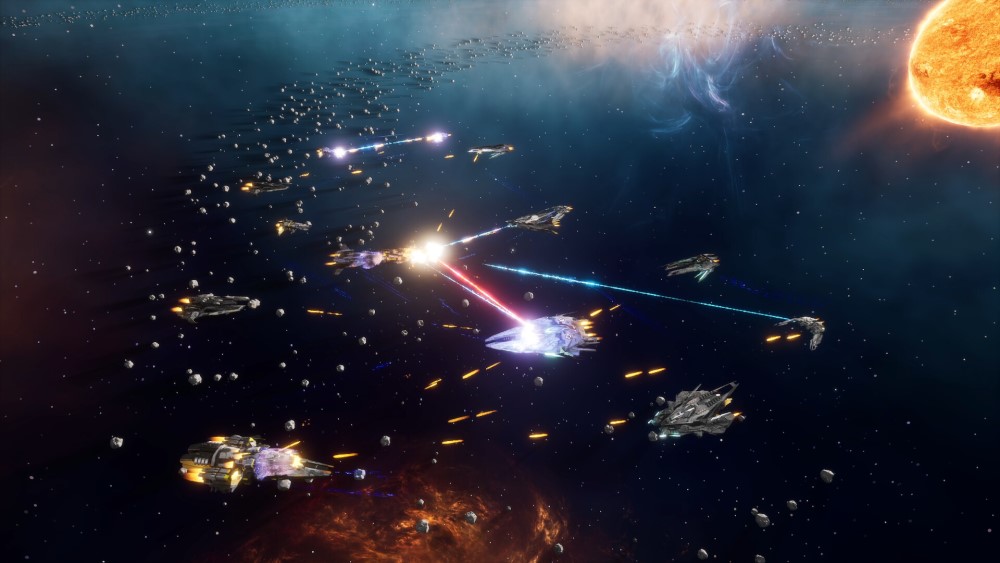
Beyond Astra is a real-time 4X sci-fi grand strategy game set in a galaxy brimming with life and intrigue!
I came across Beyond Astra, a new 4X game being developed by Nebule Games (a 2-person team), while writing my 10 Best Grand Strategy and 4X Games To Wishlist in 2025. I was so impressed by its looks that it even made the cover of the article. Soon enough, the team messaged me and I asked for an interview, which they kindly gave me.
Strategy and Wargaming: Beyond Astra is a passion project built by a solo developer. Can you tell us about the initial inspiration and motivation behind creating a grand strategy game of this scale, and what unique challenges and creative freedoms this development approach has offered?
Nebule Games: The core idea for Beyond Astra came from my love for classic strategy games like Civilization, Caesar, Empire Earth, Spore, and Master of Orion. I always dreamed of a game that would let you manage both the fine details of city-building and the grand scale of a multi-planetary empire in a single, seamless experience. Since that game didn’t exist, I decided to build it myself in 2020. I handle all the coding, Alex works with me on co-design, and we’re fortunate to collaborate with talented artists on the visuals.
The main challenge was that I’m not a trained programmer. I had to teach myself C++ and complex math from scratch, sometimes digging into very advanced academic papers to solve problems. It was a huge learning curve, but the developer community was incredibly supportive.
The biggest freedom we have now comes directly from overcoming those challenges. I’ve built a very robust technical core for the game, which means we now have the creative liberty to build the ambitious features we’ve always dreamed of.
Strategy and Wargaming: The game’s standout feature is its seamless integration of space and planet-side gameplay. Can you elaborate on the technical and design decisions that went into making this a reality, and how this feature enhances the 4X experience?
Nebule Games: You’re right, the seamless integration is the absolute core of Beyond Astra. To make it a reality, the game’s architecture had to be designed for it from day one. Commercial engines like Unreal are powerful, but they aren’t built to handle things like fully explorable spherical worlds out of the box. This meant I had to spend nearly four years on deep engine customization and R&D.
I had to develop my own solutions for critical systems like pathfinding on a sphere, managing collisions, dynamic lighting and shadows, and object occlusion across massive scales. It was a long process with many rewrites to get a version that was stable in all situations. Essentially, the seamless experience you see is the direct result of countless custom optimizations and technologies I built.
From a design perspective, this feature enhances the 4X experience by dissolving the boundaries that usually separate different layers of gameplay. It’s about creating a powerful sense of scale and presence.
- Immersion and Exploration: Being able to fly from space and land units on a planet makes exploration truly meaningful. You’re not just scanning a menu, you’re discovering unique biomes, alien wildlife, and ancient ruins.
- Tangible Empire-Building: Expansion and exploitation become concrete. You physically build your cities and space stations, seeing them grow and impact the world. It makes your empire feel real and grounded.
- Deeper Strategy: The seamlessness reinforces all gameplay mechanics. Battles, for instance, become epic real-time events where you can manage a fleet in orbit while simultaneously commanding ground units fighting for control of a city. It adds a whole new layer of tactical depth.
Strategy and Wargaming: The 4X genre is well-established. What specific aspects or common pain points of the genre did you identify that you wanted to improve or innovate upon with Beyond Astra?
Nebule Games: We focused on what we wanted to enhance: strategic balance and management freedom.
We’ve structured the gameplay around six distinct victory conditions: economic, military, diplomatic, cultural, religious, and scientific. In many games, some of these paths can feel less developed, but we’ve worked hard to ensure each one is a viable and engaging strategic choice.
Ultimately, it’s about giving players total freedom to shape their own galactic story. The game is designed with clear systems that offer granular control without being overwhelming. Bringing fully 3D planets into a space 4X makes the gameplay far more tangible, so we made sure our interfaces are clean and intuitive enough to support both grand strategy and detailed 3D management. This allows players to adapt their strategy based on their discoveries, making each game a unique and memorable narrative.
Strategy and Wargaming: With extensive customization for species and civilizations, what are some of the most unique or surprising player creations you have seen, and how do these customizations impact the strategic depth of the game?
Nebule Games: Players haven’t had a chance to experiment with civilization customization yet, as it wasn’t part of our October 2024 alpha playtest. But our philosophy for customization in Beyond Astra is to empower imagination and roleplaying while keeping the system clear and impactful, we use a more foundational approach.
Players choose a visual portrait for their species, then pair it with a broader civilization type like biological, silicic, or even robotic, and combine that with an evolutionary strategy. This sets the stage for their civilization. The customization then unfolds during the game itself through the technology, culture, and religion trees, which allow you to steer your civilization in vastly different directions.
This approach ensures that your starting choices are meaningful but don’t lock you into a single path. Additionally, you can integrate new species you encounter in the galaxy into your civilization.
Strategy and Wargaming: The game features a detailed city-building system with a focus on population satisfaction. How did you balance the micro-management of individual cities with the macro-level grand strategy of an entire civilization?
Nebule Games: You’re right, that balance is crucial. We tackled it by focusing on one simple idea: let the player decide how deep they want to go. It’s all about their choice. We provide the tools for micromanagement if you enjoy it, but we also offer powerful systems to automate and streamline if you prefer focusing on the big picture, and we expect your playstyle to evolve. You might spend more time on micromanagement early on, then naturally rely more on the macro tools as your empire expands.
Players who love city-building can meticulously place every park and building. However, for those who want to expand quickly, you can design specialized city templates for industry, agriculture, tourism, etc., and then deploy them with a few clicks on new planets.
Many systems have a degree of autonomy to make the empire feel alive without requiring constant input. Commercial routes form organically based on supply and demand, and your population goes about its daily life, finding work, visiting leisure spots, and buying goods.
We’ve put a huge emphasis on the user experience, with a centralized interface that gives you a clear overview of your empire. And of course, with slow-paced combat, active pause, and multiple speed settings, you always have time to think. The ultimate goal is to make managing a vast empire feel fluid and engaging.
Strategy and Wargaming: Beyond Astra offers seven different victory conditions. Beyond the standard military conquest, could you provide more insight into a non-military victory path and the unique challenges a player might face pursuing it? And how will the game keep those different conditions as fun as going guns blazing?
Nebule Games: We absolutely wanted non-military paths to be just as engaging. We designed them around the idea of ‘soft power’ ways to compete and win without always resorting to war. For example, take an economic victory. You can invest in another civilization by buying shares in its industries. At first, this builds good relations. But it also gives you leverage to impose penalties, and your fleets can enforce blockades.
And that’s just one path! You can become a tourism magnet, spread your ideology to convert empires from within, or use propaganda and espionage to spark coups. Territories can be conquered with influence, purchased, converted, or even pushed to become independent. Each path has its own unique strategies, and they can all intertwine with each other and with conventional warfare. The battlefields are numerous.
Strategy and Wargaming: The combat system is described as real-time, physics-based, with customizable units. Can you walk us through the design philosophy behind this system and how it differs from the more traditional turn-based or simplified real-time combat in other 4X games? It sounds like a lot, will it be taxing on players’ machines?
Nebule Games: Our core philosophy for combat is that every single unit should matter: every ship, ground unit, and city. It’s about strategically managing your customizable units to make a real difference, not just throwing massive fleets at each other and letting stats decide the winner.
The battles are intentionally slow-paced. Your units are smart and can make decisions on their own, but you can always jump in and micromanage. This allowed us to create cool, dynamic features, like interceptable projectiles or fighters that seamlessly fly from space to a planet’s surface during a battle.
Regarding performance, optimization has been a top priority from day one. We still have more tests to run, but the results from our alpha with tens of thousands of players were very encouraging. We’re doing everything we can to ensure the game is playable from start to finish on a wide range of machines.
Strategy and Wargaming: The game mentions various threats and iconic pioneers. How do these elements shape the narrative and strategic landscape, and how much of the game’s story is procedurally generated versus hand-crafted?
Nebule Games: The game is designed to let every player create their own personal space opera. The stage for that opera is the procedurally generated galaxy, which ensures that every game starts with a unique map to explore.
But within that unique galaxy, we’ve placed hand-crafted story elements to make the universe feel rich and alive. For example, you’ll encounter ‘Pioneers’ unique heroic characters scattered across the map. Each one has a small questline that tells you more about the lore of the universe and offers valuable rewards, like their direct help. To add to the drama, we also have larger, galaxy-spanning crises that start as latent threats at the beginning of the game. Depending on how the game evolves, these crises can activate, creating major strategic challenges for all civilizations.
Strategy and Wargaming: Given the focus on performance and multi-threading for a continuously evolving map, what steps have you taken to ensure the game remains stable and scalable, even in the late game with massive empires?
Nebule Games: That’s a critical point, and performance has been a priority from the start. The game is fully multi-threaded to take advantage of modern CPUs, and we use asynchronous asset loading to prevent freezes and stutters. A key focus for us is ensuring the performance curve remains gentle throughout the game, instead of falling off a cliff in the late game. While we still have more stress-testing to do, we’re deeply committed to making the experience as stable and smooth as possible.
Strategy and Wargaming: Finally, why should a grand strategy fan, or even someone new to the genre, pay attention to Beyond Astra? What will this game offer that they won’t find anywhere else?
Nebule Games: For long-time grand strategy fans, Beyond Astra is the answer to a dream many of us have had: a game where your empire feels truly tangible. We’ve broken down the walls between the space map and the planet’s surface, between 4x, grand strategy, RTS, and city-building. Your decisions don’t just change a stat on a screen; you can fly down from orbit and see them shaping real worlds, in real-time.
And if you’re new to the genre, we believe you’ll connect with the satisfaction of guiding your civilization and watching it grow. It’s about the joy of exploring a colorful, living universe and uncovering its mysteries. We’ve put a huge amount of effort into making this experience intuitive and fun.
What we offer that you won’t find anywhere else is that truly seamless experience. It’s not just a feature; it’s the heart of the game. It connects every aspect, from exploration to combat, making the universe feel like one cohesive, living place.
Ultimately, Beyond Astra is the game I’ve spent my life wanting to play. It’s a love letter to the classics, built with modern technology to deliver a sense of scale and immersion that was impossible before. We invite you to come and build your own story in that universe.
Strategy and Wargaming: Thank you so much for this amazing interview!
Beyond Astra Beta in 2025, Release in 2026
Beyond Astra is still deep in development, and the team is still working hard every day to fully realize and polish the vision they’ve described in this article. They’re currently targeting a beta for the end of this year, with a full release planned for 2026. For anyone who’d like to follow their progress and get involved, the best place is our Discord community.
Support Strategy and Wargaming
I do what I do in Strategy and Wargaming because I love to do this, and I’m never going to stop. If you would like to support me with that, you can buy me a coffee for a dollar if you’re feeling generous. If you can’t, no worries, Strategy and Wargaming will always be free, and I’d love to have you around!
Leave a Reply